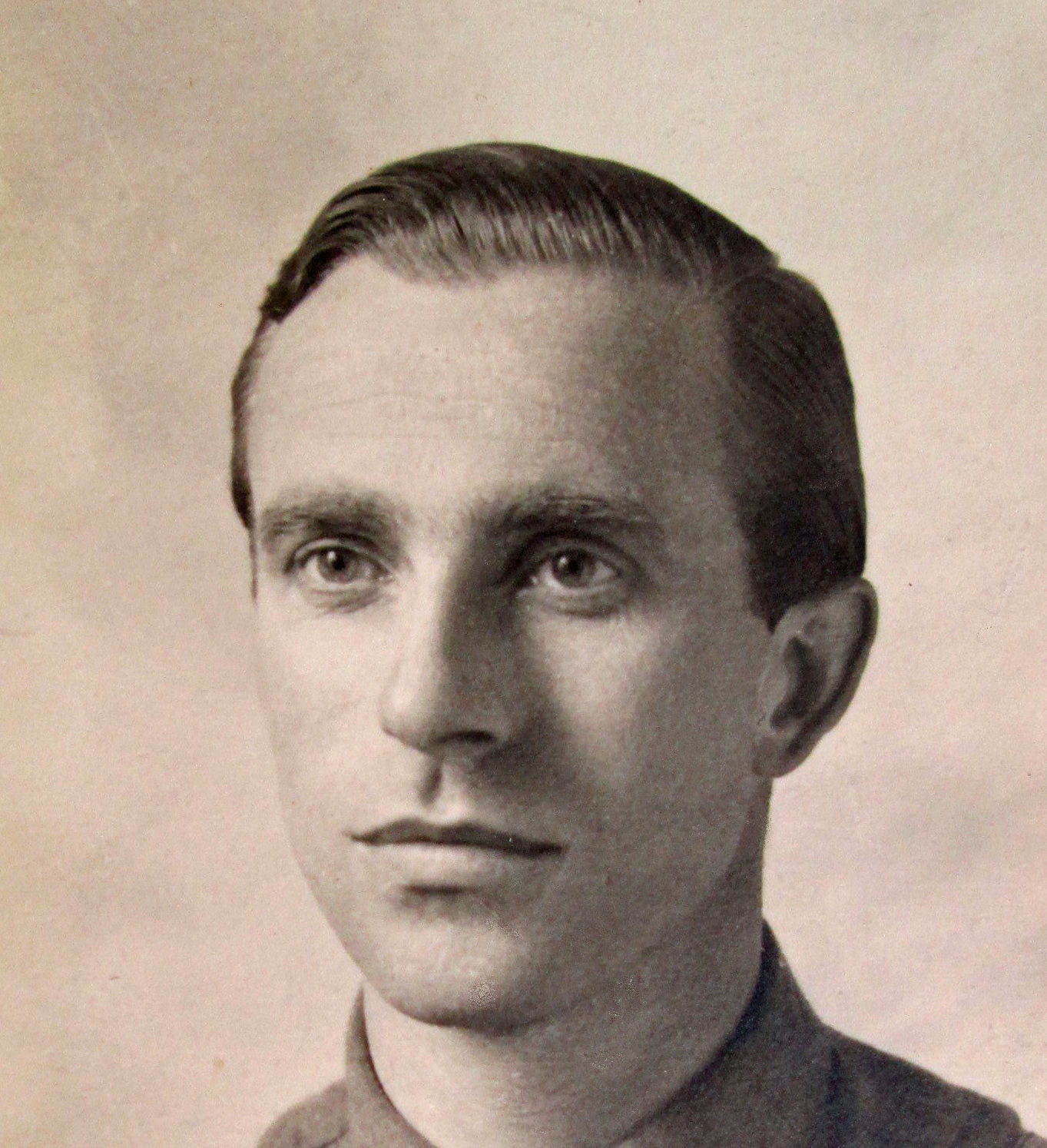
HENK VEENEKLAAS.
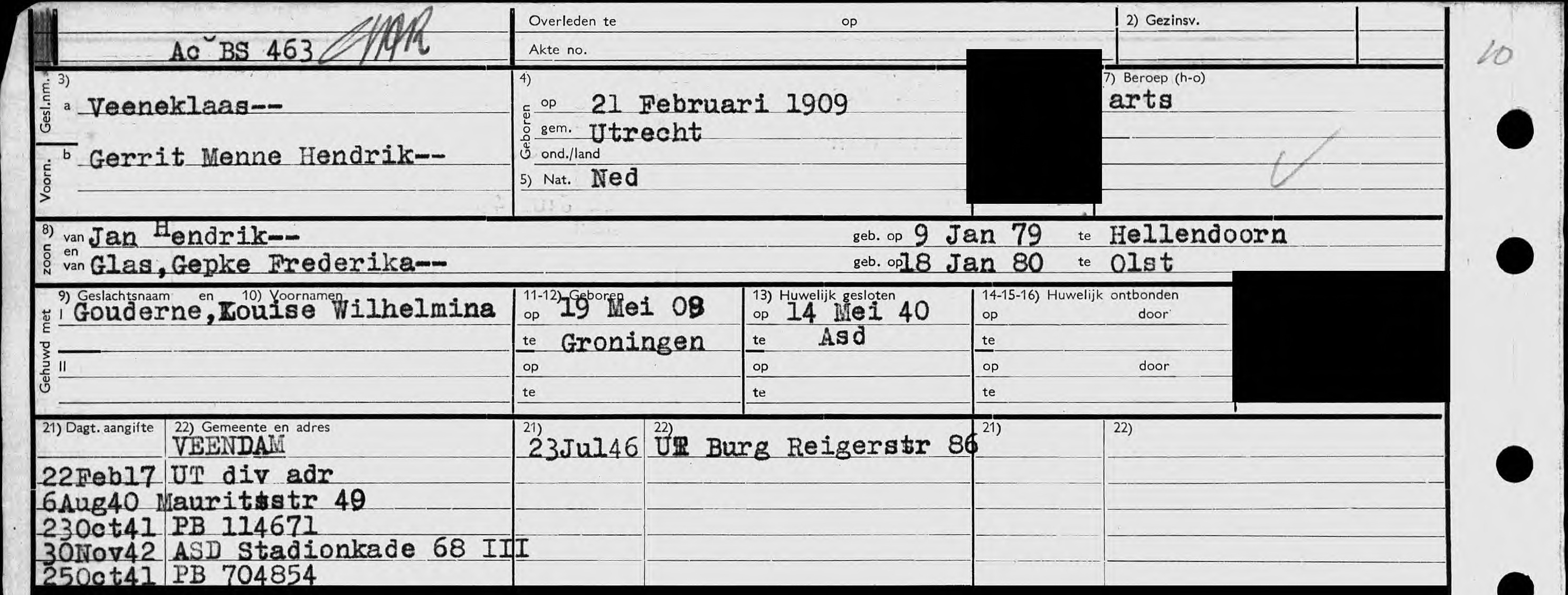
Gerrit Menne Hendrik Veeneklaas.
Born: 21February 1909 in Utrecht.
Nationality: Dutch.
Occupation: Doctor
Father Jan Hendrik Veenklaas, born 9 January 1879 in Hellendoorn, Overijssel.
Mother Gepke Frederika Glas, born 18 January 1880 in Olst, Overijssel.
Wife: Louise Wilhelmina Gouderne, born 19 May 1908 in Groningen.
Married: 14 May, 1940 in Amsterdam.
Addresses:
VEENDAM, Groningen.
22 February 1917, UTRECHT, several addresses.
6 Augustus 1940, Mauritsstraat 49.
23 October 1940, PB No. 114671.
30 November 1942, Stadionkade 68III
25 October 1941, PB No. 704854.
23 July 1946, Burgemeester Reigersstraat 86, Utrecht.
Born: 21February 1909 in Utrecht.
Nationality: Dutch.
Occupation: Doctor
Father Jan Hendrik Veenklaas, born 9 January 1879 in Hellendoorn, Overijssel.
Mother Gepke Frederika Glas, born 18 January 1880 in Olst, Overijssel.
Wife: Louise Wilhelmina Gouderne, born 19 May 1908 in Groningen.
Married: 14 May, 1940 in Amsterdam.
Addresses:
VEENDAM, Groningen.
22 February 1917, UTRECHT, several addresses.
6 Augustus 1940, Mauritsstraat 49.
23 October 1940, PB No. 114671.
30 November 1942, Stadionkade 68III
25 October 1941, PB No. 704854.
23 July 1946, Burgemeester Reigersstraat 86, Utrecht.
transcription
COPY FOR LT.COL. DOBSON 22 June 1945
TO: Lt.Col. Woolrych O.B.E.
FROM: Major Burnes
DR X visited at SF HQ in Amsterdam, where he is at present working with Captain HARRATT. He arranged for two London-trained WT-Operators to be present at the interview, and the attached report is the result of questions put to all three agents. The WT-Operators were BACKGAMMON and BOATING.
DR X was very unwilling to divulge his real name, and would not discuss his own cover or the various identities he used. he had worked before the war for approximately 15 years as a specialist in a number of Amsterdam hospitals. He is approximately 40 years old, his wife and two children are still living in Amsterdam where they lived throughout the occupation.
His first contact with the underground activity directed from London was through DRAUGHTS I (Biallosterski), who met him on his first (?) mission. Wishing to take part in subversive activity, DR X suggested to DRAUGHTS I that he could help, but insisted on remaining in the background and being unknown to anyone already working with DRAUGHTS-I's organisation.
The only exceptions to this rule were BACKGAMMON , who was housed by the doctor together with DRAUGHTS I when they arrived in September '44, and BOATING, to whom DR X was introduced later.
At first DRAUGHTS I made the doctor responsible for transporting stores from dumps north of Amsterdam to Amsterdam itself. But later, after the arrest of DRAUGHTS I, DR X took over the organisation, and he and the WT-Operators already mentioned made a very efficient team.
DR X explanation of the arrest of DRAUGHTS I was that the latter attended a reception committee which, in the opinion of the doctor, was entirely unnecessary and extremely dangerous. DRAUGHTS I was wearing at the time a pair of Canadian parachute boots, and when returning from the reception he, together with four other people travelling in the same car, was stopped by a routine control who examined their papers. All five occupants of the car were carrying doctor's papers, which fact was sufficient to arouse the suspicions of the police who controlled the car and the party was interrogated more fully, with results which are already known.
DR X pointed out that his age and experience helped to moderate the enthusiasms of his young assistants, and stated that his contacts with the medical world were invaluable in his work. In 1944 he abandoned his regular commitments at the hospitals and gave out that he was going to do research work in a big way. This enabled him to travel freely and removed any restrictions which the regular work at the hospitals might have placed upon him.
The doctor gave the impression that he had not abandoned his own name when working for resistance, but for certain activities he took false papers and adopted a cover name. He was a prominent member of the Doctors' Underground Committee, formed to resist GERMAN repressive measures, and knowing all the doctors in Amsterdam and the region, he was in possession of a very long list of useful contacts well placed to assist him in his work. He never approached any of these contacts himself on business connected with resistance, but instructed one or other of his assistance to visit a contact and recruit him without mentioning DR X's name. The person sent to recruit a new member did not even know DR X himself, and the potential recruit had no idea that his colleague
DR X had sent someone to recruit him. In this way, DR X succeeded in keeping in the background and becoming known to very few people as agent working for London, although a number of people knew him as a member of the Doctors' Committee.
transcription
REPORT DR. X
Real Name: (used - Major REERINK) Interrogated by Major BURNES
Operational Name - DR. X On 20 Jun 1945
Group - DRAUGHTS I Code No. HD 6, 7 and 8
Real Name - Lt. BRAM DE VET
Operational Name: BACKGAMMON
Group - DRAUGHTS I
Real Name - Lt. PETERS
Operational Name - BOATING
Group - DRAUGHTS I
AREA - AMSTERDAM
A. DR. X
On 9 September 1944 DRAUGHTS I and BACKGAMMON were dropped in the AMSTERDAM area and BACKGAMMON made contact with DR X through DRAUGHTS I, who had met the DR on a previous mission. From then until February 9 1945 DR X worked under DRAUGHTS I and was responsible for the transportation of all stores in the AMSTERDAM area. After 9 February 1945, DR X took over command of Resistance, because DRAUGHTS I was arrested. The dropping grounds were in NORTH-HOLLAND and the stores were brought down the canals by barges. AMSTERDAM was given first priority for arms. DR X knew a biscuit factory manager who had built for him three barges in which the boards were raised enough from the bottom to allow the hiding of explosives under the boards. 9½ centimeters was the only difference between the draught of the empty barge and that loaded with 10 tons of weapons. The painted plimsoll line was altered so no-one would notice whether or not the barge was loaded. This methode of transporting stores was only used in the AMSTERDAM area. DR X had no difficulty in persuading the biscuit factory manager to make these barges. This man had no idea who DR X really was and his co-workers had no idea at all what it was all about. When coming down from the NORTH, the barges carried a cargo of grain and potatoes so that they would look quite normal, and the crew and cargo and ship had normal papers. This was arranged with the Harbour Master in AMSTERDAM, who gave special clearance for barges he knew to be carrying stores. This man also did not know who DR X was. The Marechaussee were contacted and helped get the barges through on the canal routes, the harbour police helped over the entrances into AMSTERDAM and actually inside the town the normal police, the special food control police and the special security police helped. The latter was the most difficult to obtain help from as they were nearly all DUTCH NAZIS. The Marechaussee did not know whether these barges were coming from or going to, they merely knew they had to help get them through. They also knew that the crew had been passed by resistance. Only the head of the marechaussee knew the names of the barges and the names of the crews. Contact were always on the higher levels. For Instance, in AMSTERDAM DR X knew only the head of the harbour police. Most of the numerous contacts had never heard of DR X or knew his name, but those who did know all knew him under different names so they could not talk between themselves about him. He always used cutouts to make his contacts. For instance a priest and another man made all his contacts in the NORTH. In AMSTERDAM he had two assistants who made all his police contacts. DR X always kept in the background. The barges were unloaded at a special wharf during the night. This wharf was guarded by the police so no-one could enter. In the morning the barges went off to their normal unloading place. The reception committee received the stores which were than taken to a farm and registered. A special group of men transported them from the farm to depot barges, which were hidden in secluded canals and from which the barges were loaded. From the moment the barges were loaded until they were unloaded at the special wharf they were DR X's responsibility. At the wharf the weapon Officer of Region 10 took charge with horsedrawn vehicles and with camouflage to hide them. This was DR X's only job. In November 1944, 3500 Sten Guns were distributed - 2000 to AMSTERDAM, a few hundred to GOOI area and a few hundred to HAARLEM. When DRAUGHTS I was arrested on 9 February 1945 several other resistance members were also arrested, including the biscuit factory manager, who was killed at once. A scheme had been thought up for carrying the weapons hidden in milk tank but it was never actually used so none of those tanks were made.
After DRAUGHTS I's arrest all the dropping grounds had to be abandoned and new ones were found for the AMSTERDAM, THE HAGUE and GOOI areas. The whole of the arms passing scheme had also be abandoned and all telephone communication was lost.
A special courier system for the transporting of WT equipment and stores was built up. This consisted of parties of about 7 people on bicycles who went out into the country ostensibly to try and find food but actually to bring back the stores. There were some controls but at that time there hundreds of people roaming round the countryside on bicycles looking for food that they were very seldom searched. But as a security measure, however, the first men of the 7 always carried a suitcase, empty of incriminating material, so if he was searched nothing would be found and the delay would give the others a chance of getting away.
B. BACKGAMMOON.
BACKGAMMON was dropped on 8 September 1944 with DRAUGHTS I. They were dropped on ground MANDRILL which was used for the first time for their drop. On 13 September, he contacted DR X. BACKGAMMON was DRAUGHTS I's WT-Operator and after DRAUGHTS I was arrested he worked for DR X. He stayed at DR X's home for a month after he was dropped into HOLLAND.
C. BOATING.
BOATING was dropped on 21 September 1944. He arrived in the ROTTERDAM area and was supposed to contact someone whom he found did not exist. He then asked ENGLAND for new orders and was told to go to AMSTERDAM, where he came after ten days and got in touch with DRAUGHTS I. He also was a WT-Operator.
1. Cover.
DR X was a doctor and this profession was invaluable to him in his resistance work. He was not a G.P. and he had given up a lot of his patients so he had time to devote to resistance work. Also he was able to get around quite a bit and no-one wondered where he was. He was also able to have a permit for a bicycle. DRAUGHTS I, BACKGAMMON and BOATING were all given the cover of doctors by DR X as soon as they arrived and they also found this cover to be faultless. BACKGAMMON and BOATING became brothers and assumed the names and identity of two doctor brothers in one of the hospitals who really existed. There were therefore two sets of doctor brothers with the same names in existence. Unfortunately both sets of brothers put in for bicycle permits on the same day. The DUTCH officials in the office noticed but they worked it so that the GERMANS did not. The two WT-Operators carried about a few instruments and prescription papers so that they would look genuine, they wore doctor's armbands and had doctor's signs on their bicycles. They also learnt just a little about their medical profession in case they were ever visited by a patient. All their neighbours really believed they were young doctors. The papers they had were not forgeries but stolen ones. There was a special office, which under GERMAN supervision, issued all necessary permits for doctors, e.g. permits for bicycles, accumulators, etc and owing to DR X's high level contacts, he was able to get all sorts of papers for the two operators, including SD permits allowing them to carry firearms, and a permit which BACKGAMMON had, signed by the director of a hospital, allowing him to carry about a portable x-ray set in which he could conceal his accumulators and spares as, even if it were opened by the GERMANS, the average policeman knew so little about x-ray sets that he would not know whether it were a normal one or not. The bogus cards that were provided for them only had the names and addresses of them. They put their own photograph and fingerprints on them. BACKGAMMON's doctor papers were obtained for him by DR X within three days of his arrival. The latter also gave him suitable clothes and mede him keep his hands and nails very clean as this was essential for a man posing as a doctor. He did the same for BOATING and DRAUGHTS I. The latter was specially conspicuous before DR X gave him different clothes.
One of DR X assistants got a paper, through DR X's police contacts, saying he was working secretly for the GERMAN police.
DR X used his own name as a doctor with his former connections but his new connections never knew his real name.
2. Premisses.
After DRAUGHTS I was arrested the GERMANS started DF-ing the two WT-Operators on a vast scale. DRAUGHTS I had ordered them to do nothing without his knowledge so he knew all their WT addresses. BOATING, though, had arranged two reserve addresses without DRAUGHTS I's knowledge. One of these was lost the very day DRAUGHTS I was arrested by the owner of the house dying so only one reserve address was left. However, because of this he was therefore able to go on transmitting straight away but they had to find some more addresses, which was very difficult. A priest, a Protestant minister and a doctor did all the searching for addresses for them. DR X decided he must not know any of the WT addresses so that if he were arrested they would not all be blown again. The two operators did not know each others' addresses. When the two padres and the doctor had found them addresses, the two operators went round inspecting them to see if they were suitable. Some were not high enough, some had too thin walls. It was preferable to have unoccupied flats round the one chosen and operating always had to be done away from en adjoining apartment, especially during the night, so that the neighbours would not hear anything. The occupants of the premises chosen only knew they were being used to operate from but nothing else. The owners of those houses not chosen merely thought they were young doctors looking for somewhere to live and that the room was too dark or something like that.
The two operators never used their home for operating from. They only kept a broadcast receiver there which was kept hidden. Each operator and DR X had headquarters quite separate from their home. BACKGAMMON's headquarter was so well hidden that he thought the GERMANS would never find it. It was in the basement of a hospital and was reached through a hole in the wall (see also para 6). BOATING's was in a house opposite a school to which he had a key and there were plenty of places to hide in the school. DR X's headquarters were in a boarding house which was owned by a GERMAN lady whom he had known before the war. Up to October 1944 only GERMAN officers lived there. When they moved out no-one would take a room there so DR X took all the top floor. At first he used it as his own headquarters when he was DRAUGHTS I's transport of stores officer and then later as his headquarters when he became DRAUGHTS I's successor. Nobody knew he was there and the room was rented in someone else's name. If the house were searched while he was there he would be a doctor visiting a patient (one of his secretaries). If the two operators were there they would escape over the roof to a house opposite, the bottom floor of which had been rented by one of DR X' s girl couriers (Madeline van Geuns). Any papers that he had on him he would drop down a shaft at the back of the lavatory to the landlady in the basement. There was a hidden bell on the staircase which the landlady would ring to give him warning. If he were out the danger signal was the removal of a water can from the window sill of the kitchen.
3. Internal communications.
While DRAUGHTS I was chief, messages were passed by the secret telephone lines so that there was no danger of couriers being intercepted. When he was arrested, however, these lines were lost.
When DR X took over from DRAUGHTS I, he passed all communications by word of mouth. Every day he had meetings with the two operators at different addresses. They always arranged at one meeting where the next one would take place. At 08.30 hrs they had a sked and than met immediately afterwards. Whenever neither of them was operating or none of them were busy they usually were together. They discussed using the courier system but decided it was too dangerous unless it were done on a large scale and this would require a large number of people and a great many addresses, so that no one courier would know more than two addresses or two members of Resistance. Their cover as doctors was so good that they could always get about as much as they wanted.
4. External communications.
The two operators used several different addresses for operating from. They had several sets hidden in different places as it was extremely dangerous carrying them about. One broadcast receiver was hidden in the sliding doors between two rooms and another set was hidden behind the cardboard blackout against the window.
After DRAUGHT I's arrest when the DF-ing became very bad they asked ENGLAND for suggestions and were told to go out into the country. This was one of the worst things to do as a DF-ing car could find the area they were operating from and then the police could throw a cordon round and there would be no chance for the operator as there would be so few houses in the area to be searched. On the other hand in the town the DF-ing cars could only track the operator down to a block of flats and it would take the police so long to search every one that the operator would have plenty of time to conceal his set. As an answer to the DF-ing, the TD system was introduced. They built up their own telephone exchange to which each WT set was connected. this enabled an operator to sit in a room and tap out a message which would actually go out on a set situated some distance away. The set was tuned by somebody on the spot. These secret lines were connected partly by PTT experts and partly by the Electricity Company. Neither knew exactly what the other was doing. This was necessary because the security of these people was very bad. Where there were existing telephone lines these were used but diverted so as not to go through the central exchange. Sometimes new cables had to be laid and as most of the lines had been disconnected some had to be reconnected. This special secret telephone exchange was used in the AMSTERDAM area instead of the ordinary underground exchange as they expected the latter might be blown and they did not want to be without communications. With the TD system it was possible for each set, in a different part of the city, to work in rotation for, say, five minutes each. This completely foxed the GERMAN DF-ing cars.
* DF = Direction Finding.
There was no current in AMSTERDAM after October 1944 except in hospitals and certain big buildings. The batteries were charged with steam generators, bicycle generators or from hospitals. It was dangerous, though, to tap electricity mains as this could be detected. However they had special contacts with the Electricity Company. They applied for generators from ENGLAND in October and did not get them till March. Three generators were sent but they were too heavy and smashed on landing. The most suitable accumulator that was sent was a BRITISH accumulator. That had stamped on it "NOT TO BE DROPPED". but these always arrived in the best condition. They had to buy one tenth of their accumulators before these were dropped. It was very difficult to buy accumulators. Some of the accumulators were stolen from the GERMANS and some from telephone offices. The technical side was more difficult then the security side of their work.
5. Enemy Counter-Intelligence.
Resistance had particulars of 15 DF-ing cars but two were destroyed. The GERMANS painted them different colours every two or three weeks and they changed the numbers on them but they were easily recognisable as they were the only petrol driven cars.
The GERMANS were very active in their counter measures.
6. Security.
Outgoing messages were kept for one week as ENGLAND sometimes asked for repeats of mutilated groups a week later. This was very bad from the security point of view and it would have been much better if they could have been destroyed after a day or two. Incoming messages were nearly always destroyed after perusal. Dr X had his own code and the two operators were given his messages encoded to send off so that they did not know what he was saying. The operators had their own codes for sending their personal messages.
The WT operators had five or six bodyguards or look-outs. One of them would stand in the window and watch for danger signals from the look-outs in the streets. The signal was the removal of the right hand glove if there was danger and the removal of the left hand glove if it was very imminent. The look-outs very often used bicycles so that they would not be be too noticeable. Except for the lookout in the room from which the operating was being done, none of the others knew where precisely the WT-Operator was nor what he was doing. They were just told to patrol a certain street or square and give the signal id they saw anything suspicious.
7. Criticisme.
The papers which ENGLAND provided for the agents were extremely bad. The cover stories were also bad and the clothes were not too good. the agents arrived with very little idea of the actual conditions in the field.
8. BACKGAMMON's C.P.
BACKGAMMON's CP was situated in the basement of one of the houses of the hospital. Entrance was obtained through the house of the hospital's chief engineer, out into the garden in the centre of the hospital and down some stone stairs leading to an unlit corridor below the nurse's home. At intervals along the passage metal plates, approximately 3 ft x 3 ft, were rivetted to the wall. The first two would not come away when pulled by a hole in the middle but the third let down on chains when a piece of wire was pushed downwards through the hole to release a catch. these metal plates were about waist height. Behind the plate thus removed was a fairly large, low cellar where it was impossible to stand up straight and which was below ground level. No-one, not even the director of the hospital, knew what was happening, or that anything was happening, except the chief engineer of the hospital, Mr. [redacted], who helped BACKGAMMON to set up his Central Post. BACKGAMMON would use various covers to get to his CP - either that of a doctor, a nurse or a plumber. He nearly always rang up Mr. [redacted] before coming to see that everything was all right and he enquired again of Mr. [redacted] when he passed through his house before going down to his CP if it were still all right. The CP was equipped with everything to enable BACKGAMMON to stay down there, if necessary, for any length of time. He had in it his broadcast receiver and transmitter sets, his TD apparatus, inside and outside telephones, spare accumulators and other spares for his WT sets, food, water heating, electric light, hand grenades and firearms etc. If for any reason the warning system failed and BACKGAMMON could not get out of his CP before the police reached the passage, it would be highly probable that they would not find it and if they did he was prepared to fight it out. All the materials were taken down there at night and special rubber soled shoes were asked for from ENGLAND to enable them to walk up and down the passage. It two months to equip the CP fully. BACKGAMMON had a house telephone in his CP with a secret number which only Mr. [redacted] knew, so that the latter could ring him up to warn him of any danger. He, though, could ring up anyone from his phone both inside and outside the hospital through the secret exchange. The only snag was that certain very high pitched morse busses vibrated on the central heating pipes which ran through the cellar and could be heard in the room immediately above. So the occupant of the room above was moved out and a woman put in who knew she must not speak about any peculiar noises she might hear. One of BACKGAMMON's reasons for choosing this place for his CP was that it was safe from … end of document.
transcription
N/HO/1352 22nd March 1945.
To: D/AIR From: N
Doctor X, who is a resistance leader in the AMSTERDAM area, reports that a fighter pilot parachuted on the area of one of our dropping grounds - HUDSON coordinates 1:50.000, sheet 25, 167343.
The name of this pilot is ACZ ANDRZYDROMLEWIHZ (mutilated) and is reported to come from ops in BREDA. If you wish us to inform the 2nd SF Det. which is in the BREDA area please let us know.
Het gaat hier om P/O A. Dromlewicz, hij stortte op 15 maart 1945 om 15.55 uur neer in de buurt van Katwoude. Het toestel was een Spitfire IX, MJ787, van het Poolse 308 Squadron.
COPY FOR LT.COL. DOBSON 22 June 1945
TO: Lt.Col. Woolrych O.B.E.
FROM: Major Burnes
DR X visited at SF HQ in Amsterdam, where he is at present working with Captain HARRATT. He arranged for two London-trained WT-Operators to be present at the interview, and the attached report is the result of questions put to all three agents. The WT-Operators were BACKGAMMON and BOATING.
DR X was very unwilling to divulge his real name, and would not discuss his own cover or the various identities he used. he had worked before the war for approximately 15 years as a specialist in a number of Amsterdam hospitals. He is approximately 40 years old, his wife and two children are still living in Amsterdam where they lived throughout the occupation.
His first contact with the underground activity directed from London was through DRAUGHTS I (Biallosterski), who met him on his first (?) mission. Wishing to take part in subversive activity, DR X suggested to DRAUGHTS I that he could help, but insisted on remaining in the background and being unknown to anyone already working with DRAUGHTS-I's organisation.
The only exceptions to this rule were BACKGAMMON , who was housed by the doctor together with DRAUGHTS I when they arrived in September '44, and BOATING, to whom DR X was introduced later.
At first DRAUGHTS I made the doctor responsible for transporting stores from dumps north of Amsterdam to Amsterdam itself. But later, after the arrest of DRAUGHTS I, DR X took over the organisation, and he and the WT-Operators already mentioned made a very efficient team.
DR X explanation of the arrest of DRAUGHTS I was that the latter attended a reception committee which, in the opinion of the doctor, was entirely unnecessary and extremely dangerous. DRAUGHTS I was wearing at the time a pair of Canadian parachute boots, and when returning from the reception he, together with four other people travelling in the same car, was stopped by a routine control who examined their papers. All five occupants of the car were carrying doctor's papers, which fact was sufficient to arouse the suspicions of the police who controlled the car and the party was interrogated more fully, with results which are already known.
DR X pointed out that his age and experience helped to moderate the enthusiasms of his young assistants, and stated that his contacts with the medical world were invaluable in his work. In 1944 he abandoned his regular commitments at the hospitals and gave out that he was going to do research work in a big way. This enabled him to travel freely and removed any restrictions which the regular work at the hospitals might have placed upon him.
The doctor gave the impression that he had not abandoned his own name when working for resistance, but for certain activities he took false papers and adopted a cover name. He was a prominent member of the Doctors' Underground Committee, formed to resist GERMAN repressive measures, and knowing all the doctors in Amsterdam and the region, he was in possession of a very long list of useful contacts well placed to assist him in his work. He never approached any of these contacts himself on business connected with resistance, but instructed one or other of his assistance to visit a contact and recruit him without mentioning DR X's name. The person sent to recruit a new member did not even know DR X himself, and the potential recruit had no idea that his colleague
DR X had sent someone to recruit him. In this way, DR X succeeded in keeping in the background and becoming known to very few people as agent working for London, although a number of people knew him as a member of the Doctors' Committee.
transcription
REPORT DR. X
Real Name: (used - Major REERINK) Interrogated by Major BURNES
Operational Name - DR. X On 20 Jun 1945
Group - DRAUGHTS I Code No. HD 6, 7 and 8
Real Name - Lt. BRAM DE VET
Operational Name: BACKGAMMON
Group - DRAUGHTS I
Real Name - Lt. PETERS
Operational Name - BOATING
Group - DRAUGHTS I
AREA - AMSTERDAM
A. DR. X
On 9 September 1944 DRAUGHTS I and BACKGAMMON were dropped in the AMSTERDAM area and BACKGAMMON made contact with DR X through DRAUGHTS I, who had met the DR on a previous mission. From then until February 9 1945 DR X worked under DRAUGHTS I and was responsible for the transportation of all stores in the AMSTERDAM area. After 9 February 1945, DR X took over command of Resistance, because DRAUGHTS I was arrested. The dropping grounds were in NORTH-HOLLAND and the stores were brought down the canals by barges. AMSTERDAM was given first priority for arms. DR X knew a biscuit factory manager who had built for him three barges in which the boards were raised enough from the bottom to allow the hiding of explosives under the boards. 9½ centimeters was the only difference between the draught of the empty barge and that loaded with 10 tons of weapons. The painted plimsoll line was altered so no-one would notice whether or not the barge was loaded. This methode of transporting stores was only used in the AMSTERDAM area. DR X had no difficulty in persuading the biscuit factory manager to make these barges. This man had no idea who DR X really was and his co-workers had no idea at all what it was all about. When coming down from the NORTH, the barges carried a cargo of grain and potatoes so that they would look quite normal, and the crew and cargo and ship had normal papers. This was arranged with the Harbour Master in AMSTERDAM, who gave special clearance for barges he knew to be carrying stores. This man also did not know who DR X was. The Marechaussee were contacted and helped get the barges through on the canal routes, the harbour police helped over the entrances into AMSTERDAM and actually inside the town the normal police, the special food control police and the special security police helped. The latter was the most difficult to obtain help from as they were nearly all DUTCH NAZIS. The Marechaussee did not know whether these barges were coming from or going to, they merely knew they had to help get them through. They also knew that the crew had been passed by resistance. Only the head of the marechaussee knew the names of the barges and the names of the crews. Contact were always on the higher levels. For Instance, in AMSTERDAM DR X knew only the head of the harbour police. Most of the numerous contacts had never heard of DR X or knew his name, but those who did know all knew him under different names so they could not talk between themselves about him. He always used cutouts to make his contacts. For instance a priest and another man made all his contacts in the NORTH. In AMSTERDAM he had two assistants who made all his police contacts. DR X always kept in the background. The barges were unloaded at a special wharf during the night. This wharf was guarded by the police so no-one could enter. In the morning the barges went off to their normal unloading place. The reception committee received the stores which were than taken to a farm and registered. A special group of men transported them from the farm to depot barges, which were hidden in secluded canals and from which the barges were loaded. From the moment the barges were loaded until they were unloaded at the special wharf they were DR X's responsibility. At the wharf the weapon Officer of Region 10 took charge with horsedrawn vehicles and with camouflage to hide them. This was DR X's only job. In November 1944, 3500 Sten Guns were distributed - 2000 to AMSTERDAM, a few hundred to GOOI area and a few hundred to HAARLEM. When DRAUGHTS I was arrested on 9 February 1945 several other resistance members were also arrested, including the biscuit factory manager, who was killed at once. A scheme had been thought up for carrying the weapons hidden in milk tank but it was never actually used so none of those tanks were made.
After DRAUGHTS I's arrest all the dropping grounds had to be abandoned and new ones were found for the AMSTERDAM, THE HAGUE and GOOI areas. The whole of the arms passing scheme had also be abandoned and all telephone communication was lost.
A special courier system for the transporting of WT equipment and stores was built up. This consisted of parties of about 7 people on bicycles who went out into the country ostensibly to try and find food but actually to bring back the stores. There were some controls but at that time there hundreds of people roaming round the countryside on bicycles looking for food that they were very seldom searched. But as a security measure, however, the first men of the 7 always carried a suitcase, empty of incriminating material, so if he was searched nothing would be found and the delay would give the others a chance of getting away.
B. BACKGAMMOON.
BACKGAMMON was dropped on 8 September 1944 with DRAUGHTS I. They were dropped on ground MANDRILL which was used for the first time for their drop. On 13 September, he contacted DR X. BACKGAMMON was DRAUGHTS I's WT-Operator and after DRAUGHTS I was arrested he worked for DR X. He stayed at DR X's home for a month after he was dropped into HOLLAND.
C. BOATING.
BOATING was dropped on 21 September 1944. He arrived in the ROTTERDAM area and was supposed to contact someone whom he found did not exist. He then asked ENGLAND for new orders and was told to go to AMSTERDAM, where he came after ten days and got in touch with DRAUGHTS I. He also was a WT-Operator.
1. Cover.
DR X was a doctor and this profession was invaluable to him in his resistance work. He was not a G.P. and he had given up a lot of his patients so he had time to devote to resistance work. Also he was able to get around quite a bit and no-one wondered where he was. He was also able to have a permit for a bicycle. DRAUGHTS I, BACKGAMMON and BOATING were all given the cover of doctors by DR X as soon as they arrived and they also found this cover to be faultless. BACKGAMMON and BOATING became brothers and assumed the names and identity of two doctor brothers in one of the hospitals who really existed. There were therefore two sets of doctor brothers with the same names in existence. Unfortunately both sets of brothers put in for bicycle permits on the same day. The DUTCH officials in the office noticed but they worked it so that the GERMANS did not. The two WT-Operators carried about a few instruments and prescription papers so that they would look genuine, they wore doctor's armbands and had doctor's signs on their bicycles. They also learnt just a little about their medical profession in case they were ever visited by a patient. All their neighbours really believed they were young doctors. The papers they had were not forgeries but stolen ones. There was a special office, which under GERMAN supervision, issued all necessary permits for doctors, e.g. permits for bicycles, accumulators, etc and owing to DR X's high level contacts, he was able to get all sorts of papers for the two operators, including SD permits allowing them to carry firearms, and a permit which BACKGAMMON had, signed by the director of a hospital, allowing him to carry about a portable x-ray set in which he could conceal his accumulators and spares as, even if it were opened by the GERMANS, the average policeman knew so little about x-ray sets that he would not know whether it were a normal one or not. The bogus cards that were provided for them only had the names and addresses of them. They put their own photograph and fingerprints on them. BACKGAMMON's doctor papers were obtained for him by DR X within three days of his arrival. The latter also gave him suitable clothes and mede him keep his hands and nails very clean as this was essential for a man posing as a doctor. He did the same for BOATING and DRAUGHTS I. The latter was specially conspicuous before DR X gave him different clothes.
One of DR X assistants got a paper, through DR X's police contacts, saying he was working secretly for the GERMAN police.
DR X used his own name as a doctor with his former connections but his new connections never knew his real name.
2. Premisses.
After DRAUGHTS I was arrested the GERMANS started DF-ing the two WT-Operators on a vast scale. DRAUGHTS I had ordered them to do nothing without his knowledge so he knew all their WT addresses. BOATING, though, had arranged two reserve addresses without DRAUGHTS I's knowledge. One of these was lost the very day DRAUGHTS I was arrested by the owner of the house dying so only one reserve address was left. However, because of this he was therefore able to go on transmitting straight away but they had to find some more addresses, which was very difficult. A priest, a Protestant minister and a doctor did all the searching for addresses for them. DR X decided he must not know any of the WT addresses so that if he were arrested they would not all be blown again. The two operators did not know each others' addresses. When the two padres and the doctor had found them addresses, the two operators went round inspecting them to see if they were suitable. Some were not high enough, some had too thin walls. It was preferable to have unoccupied flats round the one chosen and operating always had to be done away from en adjoining apartment, especially during the night, so that the neighbours would not hear anything. The occupants of the premises chosen only knew they were being used to operate from but nothing else. The owners of those houses not chosen merely thought they were young doctors looking for somewhere to live and that the room was too dark or something like that.
The two operators never used their home for operating from. They only kept a broadcast receiver there which was kept hidden. Each operator and DR X had headquarters quite separate from their home. BACKGAMMON's headquarter was so well hidden that he thought the GERMANS would never find it. It was in the basement of a hospital and was reached through a hole in the wall (see also para 6). BOATING's was in a house opposite a school to which he had a key and there were plenty of places to hide in the school. DR X's headquarters were in a boarding house which was owned by a GERMAN lady whom he had known before the war. Up to October 1944 only GERMAN officers lived there. When they moved out no-one would take a room there so DR X took all the top floor. At first he used it as his own headquarters when he was DRAUGHTS I's transport of stores officer and then later as his headquarters when he became DRAUGHTS I's successor. Nobody knew he was there and the room was rented in someone else's name. If the house were searched while he was there he would be a doctor visiting a patient (one of his secretaries). If the two operators were there they would escape over the roof to a house opposite, the bottom floor of which had been rented by one of DR X' s girl couriers (Madeline van Geuns). Any papers that he had on him he would drop down a shaft at the back of the lavatory to the landlady in the basement. There was a hidden bell on the staircase which the landlady would ring to give him warning. If he were out the danger signal was the removal of a water can from the window sill of the kitchen.
3. Internal communications.
While DRAUGHTS I was chief, messages were passed by the secret telephone lines so that there was no danger of couriers being intercepted. When he was arrested, however, these lines were lost.
When DR X took over from DRAUGHTS I, he passed all communications by word of mouth. Every day he had meetings with the two operators at different addresses. They always arranged at one meeting where the next one would take place. At 08.30 hrs they had a sked and than met immediately afterwards. Whenever neither of them was operating or none of them were busy they usually were together. They discussed using the courier system but decided it was too dangerous unless it were done on a large scale and this would require a large number of people and a great many addresses, so that no one courier would know more than two addresses or two members of Resistance. Their cover as doctors was so good that they could always get about as much as they wanted.
4. External communications.
The two operators used several different addresses for operating from. They had several sets hidden in different places as it was extremely dangerous carrying them about. One broadcast receiver was hidden in the sliding doors between two rooms and another set was hidden behind the cardboard blackout against the window.
After DRAUGHT I's arrest when the DF-ing became very bad they asked ENGLAND for suggestions and were told to go out into the country. This was one of the worst things to do as a DF-ing car could find the area they were operating from and then the police could throw a cordon round and there would be no chance for the operator as there would be so few houses in the area to be searched. On the other hand in the town the DF-ing cars could only track the operator down to a block of flats and it would take the police so long to search every one that the operator would have plenty of time to conceal his set. As an answer to the DF-ing, the TD system was introduced. They built up their own telephone exchange to which each WT set was connected. this enabled an operator to sit in a room and tap out a message which would actually go out on a set situated some distance away. The set was tuned by somebody on the spot. These secret lines were connected partly by PTT experts and partly by the Electricity Company. Neither knew exactly what the other was doing. This was necessary because the security of these people was very bad. Where there were existing telephone lines these were used but diverted so as not to go through the central exchange. Sometimes new cables had to be laid and as most of the lines had been disconnected some had to be reconnected. This special secret telephone exchange was used in the AMSTERDAM area instead of the ordinary underground exchange as they expected the latter might be blown and they did not want to be without communications. With the TD system it was possible for each set, in a different part of the city, to work in rotation for, say, five minutes each. This completely foxed the GERMAN DF-ing cars.
* DF = Direction Finding.
There was no current in AMSTERDAM after October 1944 except in hospitals and certain big buildings. The batteries were charged with steam generators, bicycle generators or from hospitals. It was dangerous, though, to tap electricity mains as this could be detected. However they had special contacts with the Electricity Company. They applied for generators from ENGLAND in October and did not get them till March. Three generators were sent but they were too heavy and smashed on landing. The most suitable accumulator that was sent was a BRITISH accumulator. That had stamped on it "NOT TO BE DROPPED". but these always arrived in the best condition. They had to buy one tenth of their accumulators before these were dropped. It was very difficult to buy accumulators. Some of the accumulators were stolen from the GERMANS and some from telephone offices. The technical side was more difficult then the security side of their work.
5. Enemy Counter-Intelligence.
Resistance had particulars of 15 DF-ing cars but two were destroyed. The GERMANS painted them different colours every two or three weeks and they changed the numbers on them but they were easily recognisable as they were the only petrol driven cars.
The GERMANS were very active in their counter measures.
6. Security.
Outgoing messages were kept for one week as ENGLAND sometimes asked for repeats of mutilated groups a week later. This was very bad from the security point of view and it would have been much better if they could have been destroyed after a day or two. Incoming messages were nearly always destroyed after perusal. Dr X had his own code and the two operators were given his messages encoded to send off so that they did not know what he was saying. The operators had their own codes for sending their personal messages.
The WT operators had five or six bodyguards or look-outs. One of them would stand in the window and watch for danger signals from the look-outs in the streets. The signal was the removal of the right hand glove if there was danger and the removal of the left hand glove if it was very imminent. The look-outs very often used bicycles so that they would not be be too noticeable. Except for the lookout in the room from which the operating was being done, none of the others knew where precisely the WT-Operator was nor what he was doing. They were just told to patrol a certain street or square and give the signal id they saw anything suspicious.
7. Criticisme.
The papers which ENGLAND provided for the agents were extremely bad. The cover stories were also bad and the clothes were not too good. the agents arrived with very little idea of the actual conditions in the field.
8. BACKGAMMON's C.P.
BACKGAMMON's CP was situated in the basement of one of the houses of the hospital. Entrance was obtained through the house of the hospital's chief engineer, out into the garden in the centre of the hospital and down some stone stairs leading to an unlit corridor below the nurse's home. At intervals along the passage metal plates, approximately 3 ft x 3 ft, were rivetted to the wall. The first two would not come away when pulled by a hole in the middle but the third let down on chains when a piece of wire was pushed downwards through the hole to release a catch. these metal plates were about waist height. Behind the plate thus removed was a fairly large, low cellar where it was impossible to stand up straight and which was below ground level. No-one, not even the director of the hospital, knew what was happening, or that anything was happening, except the chief engineer of the hospital, Mr. [redacted], who helped BACKGAMMON to set up his Central Post. BACKGAMMON would use various covers to get to his CP - either that of a doctor, a nurse or a plumber. He nearly always rang up Mr. [redacted] before coming to see that everything was all right and he enquired again of Mr. [redacted] when he passed through his house before going down to his CP if it were still all right. The CP was equipped with everything to enable BACKGAMMON to stay down there, if necessary, for any length of time. He had in it his broadcast receiver and transmitter sets, his TD apparatus, inside and outside telephones, spare accumulators and other spares for his WT sets, food, water heating, electric light, hand grenades and firearms etc. If for any reason the warning system failed and BACKGAMMON could not get out of his CP before the police reached the passage, it would be highly probable that they would not find it and if they did he was prepared to fight it out. All the materials were taken down there at night and special rubber soled shoes were asked for from ENGLAND to enable them to walk up and down the passage. It two months to equip the CP fully. BACKGAMMON had a house telephone in his CP with a secret number which only Mr. [redacted] knew, so that the latter could ring him up to warn him of any danger. He, though, could ring up anyone from his phone both inside and outside the hospital through the secret exchange. The only snag was that certain very high pitched morse busses vibrated on the central heating pipes which ran through the cellar and could be heard in the room immediately above. So the occupant of the room above was moved out and a woman put in who knew she must not speak about any peculiar noises she might hear. One of BACKGAMMON's reasons for choosing this place for his CP was that it was safe from … end of document.
transcription
N/HO/1352 22nd March 1945.
To: D/AIR From: N
Doctor X, who is a resistance leader in the AMSTERDAM area, reports that a fighter pilot parachuted on the area of one of our dropping grounds - HUDSON coordinates 1:50.000, sheet 25, 167343.
The name of this pilot is ACZ ANDRZYDROMLEWIHZ (mutilated) and is reported to come from ops in BREDA. If you wish us to inform the 2nd SF Det. which is in the BREDA area please let us know.
Het gaat hier om P/O A. Dromlewicz, hij stortte op 15 maart 1945 om 15.55 uur neer in de buurt van Katwoude. Het toestel was een Spitfire IX, MJ787, van het Poolse 308 Squadron.
transcription
VEENEKLAAS, A
COPY.
BUREAU NATIONALE VELIGHEID
HQ Netherlands Security Service.
3 July 1945.
Lt. Col. Dobson.
Dear Colonel,
I have the pleasure to introduce to you Major A. Reerink, whom I know as an extremely capable and trustworthy officer. You are kindly requested to give him any help and information for the execution of his plans in the interest of my country.
Sincerely yours,
Head of the Netherlands Security Service,
(Signed) Colonel L. EINTHOVEN.
transcription
make pers file
N/HO/1495 12th July, 1945.
To: AD/P. From: N.
DOCTOR "X" (Maj. A. VEENEKLAAS @ REERINK)
The above Dutch Officer, who was in charge of our organisation in AMSTERDAM and who did an exceedingly good job of work, has now arrived in this country, ostensibly for the purpose of having a rest and seeing one or two of our schools.
He has been appointed by the head of the Netherlands Security Service, Col. L. EINTHOVEN, to help the Dutch authorities in the question of internal security, and H.R.H. Prince BERNHARD would be very grateful if Home Security Service could give Maj. REERINK a few useful hints in so far as this may be possible.
His security in HOLLAND is still exceedingly good in that he is known as Maj. A. REERINK to all concerned and will, in the future, be working behind the scenes unknown to the usual Government Departments.
He is a doctor by profession, which assisted him during the occupation for the purpose of travelling with proper documents.
I attach copy of the letter I have received from Col. EINTHOVEN to serve as introduction, the original of which Maj. REERINK still has in his possession.
transcription
DCE/3070 19th July, 1945
To: AD/P. From: D/CE
I refer to the attached N/HO/1495 of 12 July 45 concerning Dr. "X".
I have to-day sounded [redacted] who is the head of MI-5 Dutch Section, on N's proposal. [redacted] would not entertain the proposal to see or have any dealings with Dr."X" and he also told me that it would be no use if the proposal were submitted to his superiors as they would most certainly support him in his attitude.
The reason for this decision was that the Dutch Security Service is represented in London by a [redacted] with whom MI-5 have the closest liaison (Francois van 't Sant?). [redacted] told me, off the record, that MI-5 supply this Service with a certain amount of useful information and that the Dutch service is very efficient and well organised; [redacted] therefore could not interview someone who was not personally sponsored by [redacted] who would have cause for complaint if [redacted] interviewed a Dutchman on security matters. [redacted] also warned me that a few months ago a certain Dutchman attempted to get into touch with MI-5 without his own security service being informed and that there was a certain amount of unpleasantness on that occasion.
I think that [redacted] attitude is correct and reasonable and that therefore Dr. "X" must be told that he must obtain his introduction to the British security service through [redacted].
I think too, that Scotland Yard would probably adopt precisely the same attitude. It will help N at all Dr. "X" could be interviewed by BSS/D who could give him a talk on the way in which contra espionage department is worked.
Redacted under FOI
Exemption S40(2)
Closed until 2031
transcription
To: N. ADP/3483
From: AD/P 20-7-1945
I refer to your N/HO/1495.
D/CE has explained Dr. X's position to MI-5. They say they have official liaison with the official security service for Holland and that, therefore, they cannot see anyone on any security matter who is not introduced to them by the official security service, nor can they discuss security matters with any Dutchman unless he is so introduced. They further point out that in view of the fact that Dr.X appointment is to be secret it would be the very worst thing for him to come and see MI-5 who would have to report their meeting to the Dutch official service, thereby "blowing" the cover of Dr. X.
I think the best thing is to explain too Dr.X that our security service is in liaison with the official Dutch service and that, therefore, we consider it undesirable for hom to meet them since this would "blow" his cover.
transcription
July 1945
CITATION.
Subject: Major Arend REERINK.
No. Royal Netherlands Army.
Subject, a doctor by profession who had spent the war in enemy-occupied Holland, became associated in autumn 1944 with the Chief UK trained Resistance Organiser (Biallosterski) who was assuring liaison between Resistance HQ and HQ in UK.
Subject took over and successfully organised the transport of the airborne arms and material coming from the UK.
During the same period, he performed valuable service in the provision of cover, for various clandestine agents, making particular use of his medical connections for this purpose.
When the organiser was arrested in the early part of the present year, it was decided by his collaborators that subject was the person best fitted to assume his functions and subject was accordingly given this dangerous task. From that time until the Armistice carried on the work of liaison between UK and Resistance HQ, organising airborne supply operations with conspicuous succes and assuring communications between Resistance HQ and the exterior. He was faced with particular difficulties and dangers following the arrest of his predecessor and the subsequent intense activity of the enemy resulting from the information thereby gained, but he surmounted all this successfully, and the greatest credit is due to him for the services rendered at so critical a time.
transcription
NETHERLANDS SPECIAL FORCE MISSION
1 Koningslaan,
UTRECHT. Tel 15108.
No. LO/V/DG/RDW/VIII/92.
Subject: Dr. X accounts.
Ref. Your letter d.d. 15 Aug. 1945.
5 September 1945
Dear Bill,
Thank you for your letter of 15 August which I received to-day. I shall pay the amount of HFL 5525,- to Dr.X as soon as he and I are back in Utrecht.
lern equipment of £104,-.
Yours sincerely,
K. de Graaf (Capt)
To:
Capt. W.E. Mills,
M.C.I. (S.P.) War office,
Room 238, Hotel Victoria,
Northumberland Avenue,
London W.C.2.
transcription
COPY
London, 8th September 1945
To: Lt. Col. R.I. Dobson.
Dear Sir,
To-day, September 8th 1945, I opened a bank account on my name Arend Reerink, Major R.N.A. at Lloyds Bank Limited, 171 Brompton Road, London S.W.3.
I should be grateful if you could arrange that my money would be transferred on the account mentioned above.
Yours sincerely,
A. REERINK
Maj. R.N.A.
transcription
N/FD/1596 10 Sep 1945
To: D/FIN.D From: N.
Re Agent's expenses in the Field - HOLLAND. (Dr. "X").
Further to my note ref. N/FD/1580 of 22 Aug, we have now received the attached letter from the agent in question and I should be obliged if you would kindly arrange for the necessary payment to be made to the branch of Lloyd's Bank specified, letting me know when this has been done.
transcription
21st September, 1945.
TO WHOM IT MAY CONCERN:
Major A. REERINK is carrying one package addressed to Lieut. General HRH Prince BERNHARD, of the Netherlands.
This package contains official material, and it is requested that it should not be opened.
Date of Journey:
On 22nd September 1945 or as soon thereafter as flying conditions permit.
Lt. Col. G.S.
transcription
N/FD/1617. 10 Oct 1945.
To: D/FIN. From: N.
Reference my N/FD/1596 of 10 Sep 45, I have spoken to the Manager of Lloyd's Bank, Brompton Road Branch, who assures me that:
a) Major REERINK's account has been opened and that
b) The status of his account was that of an ordinary resident in this country.
I should be glad, therefore, if you will credit Major REERINK's account as soon as possible as I gather that someone to whom he issued a cheque has had it returned from the Bank.
transcription
Copy 6131 Draughts 3A
M.O.1 (S.P.)
Room 238,
25th October, 1945.
Major W.A. Murphy.
Dear Sir,
I confirm telephone conversation of this morning when I booked a room in the name of Major Reerink (Dutch Army), from Monday next, 29 October.
I am particularly grateful that the booking can be effective from Monday (and not as you first indicated, on the Tuesday) as the officer is flying here from Holland on that day, and it would obviously be most inconvenient if he had to move his luggage from one address to another.
Yours faithfully,
The Manager
Green Park Hotel,
Half Moon Street,
London, W.1.
w.mugge@home.nl
VEENEKLAAS, A
COPY.
BUREAU NATIONALE VELIGHEID
HQ Netherlands Security Service.
3 July 1945.
Lt. Col. Dobson.
Dear Colonel,
I have the pleasure to introduce to you Major A. Reerink, whom I know as an extremely capable and trustworthy officer. You are kindly requested to give him any help and information for the execution of his plans in the interest of my country.
Sincerely yours,
Head of the Netherlands Security Service,
(Signed) Colonel L. EINTHOVEN.
transcription
make pers file
N/HO/1495 12th July, 1945.
To: AD/P. From: N.
DOCTOR "X" (Maj. A. VEENEKLAAS @ REERINK)
The above Dutch Officer, who was in charge of our organisation in AMSTERDAM and who did an exceedingly good job of work, has now arrived in this country, ostensibly for the purpose of having a rest and seeing one or two of our schools.
He has been appointed by the head of the Netherlands Security Service, Col. L. EINTHOVEN, to help the Dutch authorities in the question of internal security, and H.R.H. Prince BERNHARD would be very grateful if Home Security Service could give Maj. REERINK a few useful hints in so far as this may be possible.
His security in HOLLAND is still exceedingly good in that he is known as Maj. A. REERINK to all concerned and will, in the future, be working behind the scenes unknown to the usual Government Departments.
He is a doctor by profession, which assisted him during the occupation for the purpose of travelling with proper documents.
I attach copy of the letter I have received from Col. EINTHOVEN to serve as introduction, the original of which Maj. REERINK still has in his possession.
transcription
DCE/3070 19th July, 1945
To: AD/P. From: D/CE
I refer to the attached N/HO/1495 of 12 July 45 concerning Dr. "X".
I have to-day sounded [redacted] who is the head of MI-5 Dutch Section, on N's proposal. [redacted] would not entertain the proposal to see or have any dealings with Dr."X" and he also told me that it would be no use if the proposal were submitted to his superiors as they would most certainly support him in his attitude.
The reason for this decision was that the Dutch Security Service is represented in London by a [redacted] with whom MI-5 have the closest liaison (Francois van 't Sant?). [redacted] told me, off the record, that MI-5 supply this Service with a certain amount of useful information and that the Dutch service is very efficient and well organised; [redacted] therefore could not interview someone who was not personally sponsored by [redacted] who would have cause for complaint if [redacted] interviewed a Dutchman on security matters. [redacted] also warned me that a few months ago a certain Dutchman attempted to get into touch with MI-5 without his own security service being informed and that there was a certain amount of unpleasantness on that occasion.
I think that [redacted] attitude is correct and reasonable and that therefore Dr. "X" must be told that he must obtain his introduction to the British security service through [redacted].
I think too, that Scotland Yard would probably adopt precisely the same attitude. It will help N at all Dr. "X" could be interviewed by BSS/D who could give him a talk on the way in which contra espionage department is worked.
Redacted under FOI
Exemption S40(2)
Closed until 2031
transcription
To: N. ADP/3483
From: AD/P 20-7-1945
I refer to your N/HO/1495.
D/CE has explained Dr. X's position to MI-5. They say they have official liaison with the official security service for Holland and that, therefore, they cannot see anyone on any security matter who is not introduced to them by the official security service, nor can they discuss security matters with any Dutchman unless he is so introduced. They further point out that in view of the fact that Dr.X appointment is to be secret it would be the very worst thing for him to come and see MI-5 who would have to report their meeting to the Dutch official service, thereby "blowing" the cover of Dr. X.
I think the best thing is to explain too Dr.X that our security service is in liaison with the official Dutch service and that, therefore, we consider it undesirable for hom to meet them since this would "blow" his cover.
transcription
July 1945
CITATION.
Subject: Major Arend REERINK.
No. Royal Netherlands Army.
Subject, a doctor by profession who had spent the war in enemy-occupied Holland, became associated in autumn 1944 with the Chief UK trained Resistance Organiser (Biallosterski) who was assuring liaison between Resistance HQ and HQ in UK.
Subject took over and successfully organised the transport of the airborne arms and material coming from the UK.
During the same period, he performed valuable service in the provision of cover, for various clandestine agents, making particular use of his medical connections for this purpose.
When the organiser was arrested in the early part of the present year, it was decided by his collaborators that subject was the person best fitted to assume his functions and subject was accordingly given this dangerous task. From that time until the Armistice carried on the work of liaison between UK and Resistance HQ, organising airborne supply operations with conspicuous succes and assuring communications between Resistance HQ and the exterior. He was faced with particular difficulties and dangers following the arrest of his predecessor and the subsequent intense activity of the enemy resulting from the information thereby gained, but he surmounted all this successfully, and the greatest credit is due to him for the services rendered at so critical a time.
transcription
NETHERLANDS SPECIAL FORCE MISSION
1 Koningslaan,
UTRECHT. Tel 15108.
No. LO/V/DG/RDW/VIII/92.
Subject: Dr. X accounts.
Ref. Your letter d.d. 15 Aug. 1945.
5 September 1945
Dear Bill,
Thank you for your letter of 15 August which I received to-day. I shall pay the amount of HFL 5525,- to Dr.X as soon as he and I are back in Utrecht.
lern equipment of £104,-.
Yours sincerely,
K. de Graaf (Capt)
To:
Capt. W.E. Mills,
M.C.I. (S.P.) War office,
Room 238, Hotel Victoria,
Northumberland Avenue,
London W.C.2.
transcription
COPY
London, 8th September 1945
To: Lt. Col. R.I. Dobson.
Dear Sir,
To-day, September 8th 1945, I opened a bank account on my name Arend Reerink, Major R.N.A. at Lloyds Bank Limited, 171 Brompton Road, London S.W.3.
I should be grateful if you could arrange that my money would be transferred on the account mentioned above.
Yours sincerely,
A. REERINK
Maj. R.N.A.
transcription
N/FD/1596 10 Sep 1945
To: D/FIN.D From: N.
Re Agent's expenses in the Field - HOLLAND. (Dr. "X").
Further to my note ref. N/FD/1580 of 22 Aug, we have now received the attached letter from the agent in question and I should be obliged if you would kindly arrange for the necessary payment to be made to the branch of Lloyd's Bank specified, letting me know when this has been done.
transcription
21st September, 1945.
TO WHOM IT MAY CONCERN:
Major A. REERINK is carrying one package addressed to Lieut. General HRH Prince BERNHARD, of the Netherlands.
This package contains official material, and it is requested that it should not be opened.
Date of Journey:
On 22nd September 1945 or as soon thereafter as flying conditions permit.
Lt. Col. G.S.
transcription
N/FD/1617. 10 Oct 1945.
To: D/FIN. From: N.
Reference my N/FD/1596 of 10 Sep 45, I have spoken to the Manager of Lloyd's Bank, Brompton Road Branch, who assures me that:
a) Major REERINK's account has been opened and that
b) The status of his account was that of an ordinary resident in this country.
I should be glad, therefore, if you will credit Major REERINK's account as soon as possible as I gather that someone to whom he issued a cheque has had it returned from the Bank.
transcription
Copy 6131 Draughts 3A
M.O.1 (S.P.)
Room 238,
25th October, 1945.
Major W.A. Murphy.
Dear Sir,
I confirm telephone conversation of this morning when I booked a room in the name of Major Reerink (Dutch Army), from Monday next, 29 October.
I am particularly grateful that the booking can be effective from Monday (and not as you first indicated, on the Tuesday) as the officer is flying here from Holland on that day, and it would obviously be most inconvenient if he had to move his luggage from one address to another.
Yours faithfully,
The Manager
Green Park Hotel,
Half Moon Street,
London, W.1.
w.mugge@home.nl