SECOND REPORT AND CONSEQUENTIES OF THE FIRST MISSION.
TRANSCRIPTIE HS9/1463/3
226666/A Bayswater File 25th July, 1944
INTERROGATION OF BIALLOSTERSKI @ BRUIN @ DRAUGHTS. 298(a)
Biallosterski, who was dropped in Holland on the night of the 31st March-1st April, 1944 as organiser of a special mission, was interrrogated at Baywater on the 25th July in order to supplement the written report of his mission, contacts etc which he had already made to N Section and the Dutch Government.
(Tijdens zijn verblijf in Madrid heeft Tobias al een voorlopig rapport geschreven onder de naam van OLIVER. Meer rapporten zijn tot nu toe niet boven water gekomen. Dit rapport is 2½ week na zijn terugkeer in Engeland opgemaakt)
1. The Underground Press in Holland.
Source (Biallosterski) stated that the Underground Press is the most widespread organisation at present working in Holland. It covers all the big towns and the greater part of the country; the country is covered in such a way that every district can and usually does receive a copy of at least one of the Underground Papers.
The names of the large papers are:-
a) TROUW, which is a very big paper and used to have a very big circulation indeed, but owing to recent
arrests this has been somewhat reduced lately.
b) JE MAINTIENDRAI
c) CHRISTOPHOOR, a big Catholic paper with its circulation chiefly in South-Holland, which is the most
Catholic part of the country; this paper has grown very much from a small beginning.
d) HET PAROOL.
The larger papers are all printed, but the majority of Communist papers are stencilledand duplicated.
a) TROUW. This paper is printed in different parts of the country and there was a time in the Summer and Autumn of 1943 when it was being produced by no fewer than 7 printers in different parts of Holland. It was a very well organised paper but undoubtedly there was a serious danger in having so many printers, each one in charge of the distribution of the copies which he printed, but printing identical issues, the draft for which they received from the Headquarters of the editorial Establishment in Utrecht, the copy being delivered to the printers through a series of cut-outs.
This paper had a very wide scope and included in its excutive both Catholics and Protestants of every shade of political opinion, though the leadership was definitely Conservative. In addition to the publication of the paper the organisation also dabbled in other matters. It is known to have organised raids on Food offices and has been instrumental in securing the liquidation of some traitors. The organisation also had an escape route, though source had no knowledge of its activities. (Dus niet alleen Parool maar ook Trouw beschikte over een ontsnappings organisatie.)
Source knew a certain amount about TROUW as anyone must who has worked with the Underground Press, since this paper at its best had a circulation of from 70-80.000 copies, but he knew no real details of the personalities involved. He, however, understood that the crop of arrests which came about were due to the Germans in some way or another getting hold of one of the printers. (This probably concerns a number of distributors who were arrested in Utrecht on 27 September 1943. This arrest was the result of the capture of several Trouw distributors from Zeeland, who had been apprehended around early September along with the Zeeland LO leadership..)
d) HET PAROLE (Parool) Source worked with this paper in Holland on the technical side and also to some extent in the distribution before he came to the U.K. for the first time. He had not come across MEYER SLUYSER, though he had had contact with the new Dutch Minister for Justice (who recently came to the U.K. under the alias of BLAKE) who was at the time in Holland and connected with the paper under the name of PIETER 't HOEN (Frans Goedhart).
At this time Parole had a circulation of approximately 25.000 copies and whole of the organisation was handled by 4 or 5 men. The Editorial Staff saw nearly every Underground Paper as it was issued and had a very good information department, where all the different papers were filed and where they also collected interesting material on the subject of German propaganda: in a paper of this size and standings its records were frequently made available to other Underground Papers, especially the smaller ones, who had no records of their own and who wished to draw upon them for material.
2. Smaller Papers.
In addition to these papers above named, Source knew of some smaller, less important papers in Holland. He had never come across a paper called HET CONTRA SIGNAAL (i.c. the single sheet in which
Van BILSEN was denounced as a traitor) but he had heard of a Communist paper called SIGNAAL which was a small stencilled paper which made a somewhat sporadic appearance. There was another very small paper called VOD which circulated only through the hands of Underground Workers and which gave a resume of news from the BBC and and descriptions of members of the SD and Gestapo with, wherever possible, their photographs.
Source had also once seen a copy of DIE STEMME VAN VRIJ NEDERLAND (i.e. the paper with Van BILSEN claimed to be connected) and stated that he thought it was a very new paper, its circulation was small and Source is under the impression that it only started in the spring of 1944.
There was also another paper with a fairly large circulation called DE PLOEG, which started business in the Autumn of 1943 and was sponsored by the party of Dr. Colijn.
(Frans van Bilsen was certainly not a traitor; he helped Ubbink and Dourlein go into hiding after their escape from Haaren prison and even housed them for some time.).
3. BRUTUS (SOE agent Johan Grün)
Source was questioned very carefully on the subject of BRUTUS, but was himself quite unable to offer any explanation although in the main he confirmed the facts to be as they had been reconstructed in London over the last few months.
The knowledge of the microphoto which BRUTUS carried, which it is thought that the enemy have it, is difficult to explain in view of the fact that Source said that he had heard about this photograph, which he described quite accurately, from one of the leaders of L.O; this man had, it appears, actually seen the photograph, which had been shown to him by another man in the same organisation sometime in the autumn of 1943, possibly October, who had stated then that it was the introduction from the Dutch Government for BRUTUS. Source had ascertained that BRUTUS had most certainly had several meetings with a large number of people holding very high positions in the Dutch Underground Press; this Source thinks was a very extraordinary action to take in view of the risks which were involved and also of the fact that the Underground Press in Holland is so organised that it is quite unnecessary to have any contacts, other than two or three with chosen liaison agents.
(Johan Grün heeft twee mircrofoto's aan Joop Stallinga gegeven terwijl hij en Grün op bezoek waren bij Janny Rebel in Amsterdam)
Source stated that he had been told by APOLLO that he (Apollo) had met BRUTUS in Brussells for diner with George van Vliet; when told by Interrogator that we had understood that Apollo and Brutus had never seen each other again after making their forced landing in Belgium, Source reiterated that he had certainly gained this impression from Apollo, but could not be absolutely sure that the fact was stated in so many words. (Wanneer Brutus en Apollo op de crashsite uit elkaar gaan, wensen zij elkaar een goede reis en 'tot ziens in Brussel'. In het door Grün geschreven boek 'Ik was geheim agent' komt een ontmoeting met Apollo (van Schelle) niet voor).
While Source was in Holland he knew that BRUTUS had arrived in Holland and was in fact living in Doorn at one time; when asked whether he could throw any light upon the story of a DODO which was told by Lieutenant HURST of the USAAF and had known of a DODO who was also at one time in Doorn, but disappeared from that town after Brutus arrived.
Upon Lieut. Hurst's description of DODO or BRUTUS being read to him Source stated quite definitely that it was a description of BRUTUS and that it could not be DODO, of whom he knew, because that man had a big round face. Source had no knowledge of any book-seller in Doorn who might be involved in the story.
226666/A Bayswater File 25th July, 1944
INTERROGATION OF BIALLOSTERSKI @ BRUIN @ DRAUGHTS. 298(a)
Biallosterski, who was dropped in Holland on the night of the 31st March-1st April, 1944 as organiser of a special mission, was interrrogated at Baywater on the 25th July in order to supplement the written report of his mission, contacts etc which he had already made to N Section and the Dutch Government.
(Tijdens zijn verblijf in Madrid heeft Tobias al een voorlopig rapport geschreven onder de naam van OLIVER. Meer rapporten zijn tot nu toe niet boven water gekomen. Dit rapport is 2½ week na zijn terugkeer in Engeland opgemaakt)
1. The Underground Press in Holland.
Source (Biallosterski) stated that the Underground Press is the most widespread organisation at present working in Holland. It covers all the big towns and the greater part of the country; the country is covered in such a way that every district can and usually does receive a copy of at least one of the Underground Papers.
The names of the large papers are:-
a) TROUW, which is a very big paper and used to have a very big circulation indeed, but owing to recent
arrests this has been somewhat reduced lately.
b) JE MAINTIENDRAI
c) CHRISTOPHOOR, a big Catholic paper with its circulation chiefly in South-Holland, which is the most
Catholic part of the country; this paper has grown very much from a small beginning.
d) HET PAROOL.
The larger papers are all printed, but the majority of Communist papers are stencilledand duplicated.
a) TROUW. This paper is printed in different parts of the country and there was a time in the Summer and Autumn of 1943 when it was being produced by no fewer than 7 printers in different parts of Holland. It was a very well organised paper but undoubtedly there was a serious danger in having so many printers, each one in charge of the distribution of the copies which he printed, but printing identical issues, the draft for which they received from the Headquarters of the editorial Establishment in Utrecht, the copy being delivered to the printers through a series of cut-outs.
This paper had a very wide scope and included in its excutive both Catholics and Protestants of every shade of political opinion, though the leadership was definitely Conservative. In addition to the publication of the paper the organisation also dabbled in other matters. It is known to have organised raids on Food offices and has been instrumental in securing the liquidation of some traitors. The organisation also had an escape route, though source had no knowledge of its activities. (Dus niet alleen Parool maar ook Trouw beschikte over een ontsnappings organisatie.)
Source knew a certain amount about TROUW as anyone must who has worked with the Underground Press, since this paper at its best had a circulation of from 70-80.000 copies, but he knew no real details of the personalities involved. He, however, understood that the crop of arrests which came about were due to the Germans in some way or another getting hold of one of the printers. (This probably concerns a number of distributors who were arrested in Utrecht on 27 September 1943. This arrest was the result of the capture of several Trouw distributors from Zeeland, who had been apprehended around early September along with the Zeeland LO leadership..)
d) HET PAROLE (Parool) Source worked with this paper in Holland on the technical side and also to some extent in the distribution before he came to the U.K. for the first time. He had not come across MEYER SLUYSER, though he had had contact with the new Dutch Minister for Justice (who recently came to the U.K. under the alias of BLAKE) who was at the time in Holland and connected with the paper under the name of PIETER 't HOEN (Frans Goedhart).
At this time Parole had a circulation of approximately 25.000 copies and whole of the organisation was handled by 4 or 5 men. The Editorial Staff saw nearly every Underground Paper as it was issued and had a very good information department, where all the different papers were filed and where they also collected interesting material on the subject of German propaganda: in a paper of this size and standings its records were frequently made available to other Underground Papers, especially the smaller ones, who had no records of their own and who wished to draw upon them for material.
2. Smaller Papers.
In addition to these papers above named, Source knew of some smaller, less important papers in Holland. He had never come across a paper called HET CONTRA SIGNAAL (i.c. the single sheet in which
Van BILSEN was denounced as a traitor) but he had heard of a Communist paper called SIGNAAL which was a small stencilled paper which made a somewhat sporadic appearance. There was another very small paper called VOD which circulated only through the hands of Underground Workers and which gave a resume of news from the BBC and and descriptions of members of the SD and Gestapo with, wherever possible, their photographs.
Source had also once seen a copy of DIE STEMME VAN VRIJ NEDERLAND (i.e. the paper with Van BILSEN claimed to be connected) and stated that he thought it was a very new paper, its circulation was small and Source is under the impression that it only started in the spring of 1944.
There was also another paper with a fairly large circulation called DE PLOEG, which started business in the Autumn of 1943 and was sponsored by the party of Dr. Colijn.
(Frans van Bilsen was certainly not a traitor; he helped Ubbink and Dourlein go into hiding after their escape from Haaren prison and even housed them for some time.).
3. BRUTUS (SOE agent Johan Grün)
Source was questioned very carefully on the subject of BRUTUS, but was himself quite unable to offer any explanation although in the main he confirmed the facts to be as they had been reconstructed in London over the last few months.
The knowledge of the microphoto which BRUTUS carried, which it is thought that the enemy have it, is difficult to explain in view of the fact that Source said that he had heard about this photograph, which he described quite accurately, from one of the leaders of L.O; this man had, it appears, actually seen the photograph, which had been shown to him by another man in the same organisation sometime in the autumn of 1943, possibly October, who had stated then that it was the introduction from the Dutch Government for BRUTUS. Source had ascertained that BRUTUS had most certainly had several meetings with a large number of people holding very high positions in the Dutch Underground Press; this Source thinks was a very extraordinary action to take in view of the risks which were involved and also of the fact that the Underground Press in Holland is so organised that it is quite unnecessary to have any contacts, other than two or three with chosen liaison agents.
(Johan Grün heeft twee mircrofoto's aan Joop Stallinga gegeven terwijl hij en Grün op bezoek waren bij Janny Rebel in Amsterdam)
Source stated that he had been told by APOLLO that he (Apollo) had met BRUTUS in Brussells for diner with George van Vliet; when told by Interrogator that we had understood that Apollo and Brutus had never seen each other again after making their forced landing in Belgium, Source reiterated that he had certainly gained this impression from Apollo, but could not be absolutely sure that the fact was stated in so many words. (Wanneer Brutus en Apollo op de crashsite uit elkaar gaan, wensen zij elkaar een goede reis en 'tot ziens in Brussel'. In het door Grün geschreven boek 'Ik was geheim agent' komt een ontmoeting met Apollo (van Schelle) niet voor).
While Source was in Holland he knew that BRUTUS had arrived in Holland and was in fact living in Doorn at one time; when asked whether he could throw any light upon the story of a DODO which was told by Lieutenant HURST of the USAAF and had known of a DODO who was also at one time in Doorn, but disappeared from that town after Brutus arrived.
Upon Lieut. Hurst's description of DODO or BRUTUS being read to him Source stated quite definitely that it was a description of BRUTUS and that it could not be DODO, of whom he knew, because that man had a big round face. Source had no knowledge of any book-seller in Doorn who might be involved in the story.
Source (Biallosterski) explained that L.O. is a very big organisation and that certainly most of the people in it with whom he came into contact seemed to know the details of the Brutus story and without exception the whole of the Underground Press knew the story with all its details and implications. On account of this part of Source's mission, which was to warn the Underground Press of possible danger in contacts with Brutus was unnecessary as all security precautions had been taken and no harm ever arose that could be traceable to Brutus. Source was at some trouble to try to check up on the story and visited a great many people who had at one time or another been in contact with the man who was alleged to be Brutus, all these people without exception gave the decription of the real Brutus, even down to the mark on the left ear. Later on in his stay in Holland Source had heard a report to the effect that the Underground Press knew that this man (Brutus) was working for the Gestapo; one of the Editors of PAROLE told Source that once when he had been to Amsterdam to see Brutus he had a suspiction on the return journey that he was being followed, but acting on this impulse he jumped out of the train when it was slowing down before the station at Driebergen and kept clear of any of Brutus contacts from that time. Source has never understood why Brutus should have contacted the Editors of the papers, which was very dangerous for both parties and quite unnecessary. If he was in fact working under control he was perfectly well placed to give a warning to his contacts, but this he never did. Certainly everybody in Holland was very pleased to see Brutus in his capacity as an emissary from London and they treated him as a very big (important) man. It is remarkable therefore that if he was at any time working under control he did not catch a great many people since he was certainly in a position to do so. After the tale of Brutus got spread around everybody naturally cut their contacts and since then nothing more has ever been seen or heard of him.
Source suggests that possibly the new Dutch Minister of Justice JONKHEER VAN HEUVEN GOEDHART who is now in the UK may have something further upon this matter since he was in Holland at the relevant time and was intimately connected with the Underground Press.
(Johan Grün, alias Brutus, was arrested on 3 January 1944 at the Driebergen train station while on his way to a meeting in Utrecht with George van Vliet, alias George Ridderhof, a Gestapo infiltrator. In his book “Ik was geheim agent” (I Was a Secret Agent), Grün describes the events following his arrest, showing that he made no attempts to establish contacts on behalf of the Germans.)
Source suggests that possibly the new Dutch Minister of Justice JONKHEER VAN HEUVEN GOEDHART who is now in the UK may have something further upon this matter since he was in Holland at the relevant time and was intimately connected with the Underground Press.
(Johan Grün, alias Brutus, was arrested on 3 January 1944 at the Driebergen train station while on his way to a meeting in Utrecht with George van Vliet, alias George Ridderhof, a Gestapo infiltrator. In his book “Ik was geheim agent” (I Was a Secret Agent), Grün describes the events following his arrest, showing that he made no attempts to establish contacts on behalf of the Germans.)
4. R.V.V.
Source was in contact with L.O. and knows that there is a liaison between the L.O. and R.V.V. He had heard further while he was in Holland that the RVV had suffered a good deal of penetration by the Germans, although so far as he could tell LO was not affected by this. The information nevertheless prevented him from trying to make contact with the RVV.
In 1943 Source had seen 3 leaflets issued by the RVV which made it appear as though it was a very big organisation which was trying to coordinate Underground activity in Holland. He added however, that he had never seen any big (major) work of the RVV.
Source had been approached by the Dutch authorities in London with a project to contact the RVV, but he had said that LO was more isolated and conservative in outlook than the RVV and suggested that it would be adviseable to contact LO first and make contact with RVV through them along the lines which which should appear best in their eyes. Source stated very definitely that when the late N asked him to contact the RVV he only agreed to make this contact on behalf of othersafter a good deal of persuasion and then stipulated that he must personally have full control of security; he states that the agents who were subsequently sent to the RVV were sent by some other means than those which he proposed and that he thinks that the whole thing was wrong, since the general impression in Holland is that the RVV, despite their own version of themselves, is in reality a very small organisation which is fairly thoroughly penetrated.
When asked for his views upon the connection between the RVV and the RADIO DIENST Source stated that in his view penetration of the RVV must extend to the Radio Dienst, but that penetration of the Radio Dienst need not necessarily extend to the RVV. Source stated that he would not agree to go to the RVV, from what he has heard about about it in Holland since he thinks it is penetrated and he is of the opinion that if it is so, as he thinks it is, the enemy must have knowledge of the Radio Dienst.
(How Tobias Biallosterski came to the idea that the RVV was heavily infiltrated remains a mystery. It is also unclear whom he ultimately spoke to about this matter—perhaps with Mr. H.B.S. Holla from Vught, whom Tobias met several times during his first mission.)
Source had never heard of any of the alleged contacts with RVV which were given by KNOPPERS he had however,
(Knoppers, alias SARGENT, worked for the Germans and was transferred to England via an escape line controlled by the Germans to be trained there as an agent, who would then be dropped into the Netherlands with all the knowledge he had acquired. However, this plan did not go through, as Knoppers was exposed in England.).
come into contact with RVV indirectly in another way through a relation of his called BALDER from a place called Broek-op-Langendijk, who was very Protestant in outlook and had been working for the RVV for about a year. Through him he discovered that the RVV had no escape-route of its own.
This man BALDER is in many ways an extraordinary person since he has so far escaped any form of trouble although in addition to his work with the RVV he is a local director for no less than three Underground papers; JE MAINTIENDRAI, HET PAROLE and TROUW, while he is also always ready to help anyone, at one time had 6 Jews in hiding in his house; further more this man had a contact with the leader of the O.D. in Alkmaar which Source considers very dangerous as they are on the whole bad workers; this long spell of immunity is probably due to the fact that BALDER lives in a small country district where there are very few NSB-ers and where the police are patriots. The local Commander of the MARECHAUSSEE being one of the foremost people in the helping of Allied Airmen.
L.O.
Questioned further on the LO Source states that in his opinion it is a very good organisation. It is very large, possibly the largest in Holland, but it is very organised on the cell system. The main activities of the LO are the support of people living illegally. Such people from all over Holland draw a subsistence allowance of 20 Guilders a week from the organisation which is provided by a large fund with a capital of 500.000 Guilders which they have raised on a guarantee of repayment by the Dutch Government after the war, which arrangement Source thinks was made with London at the beginning of 1944 through their agents in neutral countries. Source stated that LO had carried out the attack on the registration offices in Tilburg and stated that the plan was very well conceived and executed by local members of the organisation, the names of some of which he had heard. Source had not, however, ever recollected having heard any of the names of Tilburg about which doubt excists at the present time in London.
DEKKER & GEMMEKE.
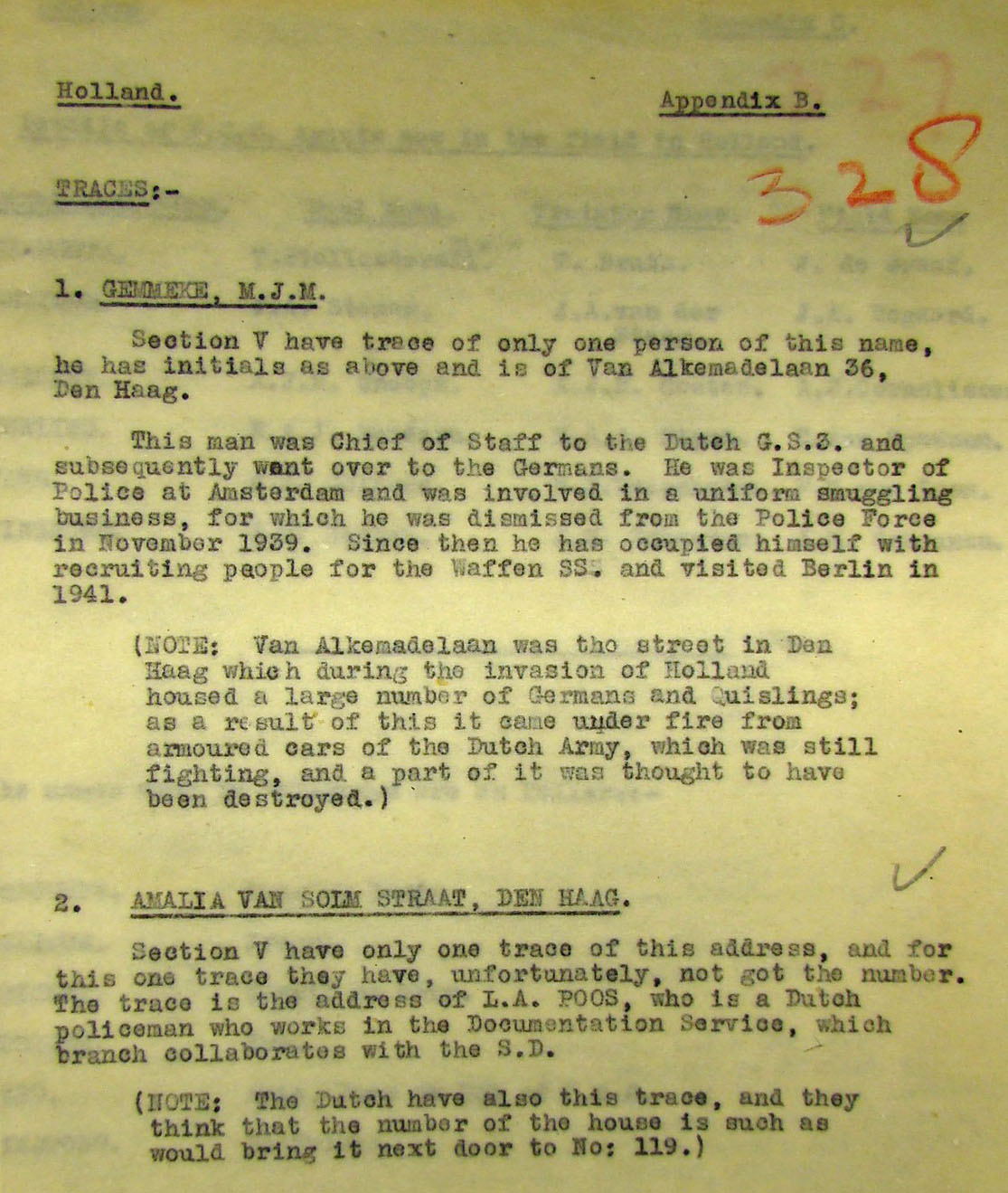
Source gave a perfectly reasonable explanation of the curious co-incidence of the names of the people who he had left in contact with his mission in the field. He knows the people upon whom adverse traces excist and one of them is indeed the brother of a man (Jos Gemmeke, een vrouw) he is using.
Return to the U.K.
Source has made a seperate field report on the circumstances of his exfiltration.
Future Missions.
Source is of the opinion that with things as they are at the present time in Holland it is only desireable to send very reliable and if possible experienced agents to that country and then to send them to no organisation except on eof which first hand evidence as to its security is available,
Source was in contact with L.O. and knows that there is a liaison between the L.O. and R.V.V. He had heard further while he was in Holland that the RVV had suffered a good deal of penetration by the Germans, although so far as he could tell LO was not affected by this. The information nevertheless prevented him from trying to make contact with the RVV.
In 1943 Source had seen 3 leaflets issued by the RVV which made it appear as though it was a very big organisation which was trying to coordinate Underground activity in Holland. He added however, that he had never seen any big (major) work of the RVV.
Source had been approached by the Dutch authorities in London with a project to contact the RVV, but he had said that LO was more isolated and conservative in outlook than the RVV and suggested that it would be adviseable to contact LO first and make contact with RVV through them along the lines which which should appear best in their eyes. Source stated very definitely that when the late N asked him to contact the RVV he only agreed to make this contact on behalf of othersafter a good deal of persuasion and then stipulated that he must personally have full control of security; he states that the agents who were subsequently sent to the RVV were sent by some other means than those which he proposed and that he thinks that the whole thing was wrong, since the general impression in Holland is that the RVV, despite their own version of themselves, is in reality a very small organisation which is fairly thoroughly penetrated.
When asked for his views upon the connection between the RVV and the RADIO DIENST Source stated that in his view penetration of the RVV must extend to the Radio Dienst, but that penetration of the Radio Dienst need not necessarily extend to the RVV. Source stated that he would not agree to go to the RVV, from what he has heard about about it in Holland since he thinks it is penetrated and he is of the opinion that if it is so, as he thinks it is, the enemy must have knowledge of the Radio Dienst.
(How Tobias Biallosterski came to the idea that the RVV was heavily infiltrated remains a mystery. It is also unclear whom he ultimately spoke to about this matter—perhaps with Mr. H.B.S. Holla from Vught, whom Tobias met several times during his first mission.)
Source had never heard of any of the alleged contacts with RVV which were given by KNOPPERS he had however,
(Knoppers, alias SARGENT, worked for the Germans and was transferred to England via an escape line controlled by the Germans to be trained there as an agent, who would then be dropped into the Netherlands with all the knowledge he had acquired. However, this plan did not go through, as Knoppers was exposed in England.).
come into contact with RVV indirectly in another way through a relation of his called BALDER from a place called Broek-op-Langendijk, who was very Protestant in outlook and had been working for the RVV for about a year. Through him he discovered that the RVV had no escape-route of its own.
This man BALDER is in many ways an extraordinary person since he has so far escaped any form of trouble although in addition to his work with the RVV he is a local director for no less than three Underground papers; JE MAINTIENDRAI, HET PAROLE and TROUW, while he is also always ready to help anyone, at one time had 6 Jews in hiding in his house; further more this man had a contact with the leader of the O.D. in Alkmaar which Source considers very dangerous as they are on the whole bad workers; this long spell of immunity is probably due to the fact that BALDER lives in a small country district where there are very few NSB-ers and where the police are patriots. The local Commander of the MARECHAUSSEE being one of the foremost people in the helping of Allied Airmen.
L.O.
Questioned further on the LO Source states that in his opinion it is a very good organisation. It is very large, possibly the largest in Holland, but it is very organised on the cell system. The main activities of the LO are the support of people living illegally. Such people from all over Holland draw a subsistence allowance of 20 Guilders a week from the organisation which is provided by a large fund with a capital of 500.000 Guilders which they have raised on a guarantee of repayment by the Dutch Government after the war, which arrangement Source thinks was made with London at the beginning of 1944 through their agents in neutral countries. Source stated that LO had carried out the attack on the registration offices in Tilburg and stated that the plan was very well conceived and executed by local members of the organisation, the names of some of which he had heard. Source had not, however, ever recollected having heard any of the names of Tilburg about which doubt excists at the present time in London.
DEKKER & GEMMEKE.
Source gave a perfectly reasonable explanation of the curious co-incidence of the names of the people who he had left in contact with his mission in the field. He knows the people upon whom adverse traces excist and one of them is indeed the brother of a man (Jos Gemmeke, een vrouw) he is using.
Return to the U.K.
Source has made a seperate field report on the circumstances of his exfiltration.
Future Missions.
Source is of the opinion that with things as they are at the present time in Holland it is only desireable to send very reliable and if possible experienced agents to that country and then to send them to no organisation except on eof which first hand evidence as to its security is available,
TRANSLATION 368
14.8.44
INTERROGATION OF THE AGENT BRUIN IN CONNECTION WITH THE REPORT RECEIVED
FROM THE S.O.E. SECURITY CONCERNING THE EXECUTION OF THE ILLEGAL MISSION
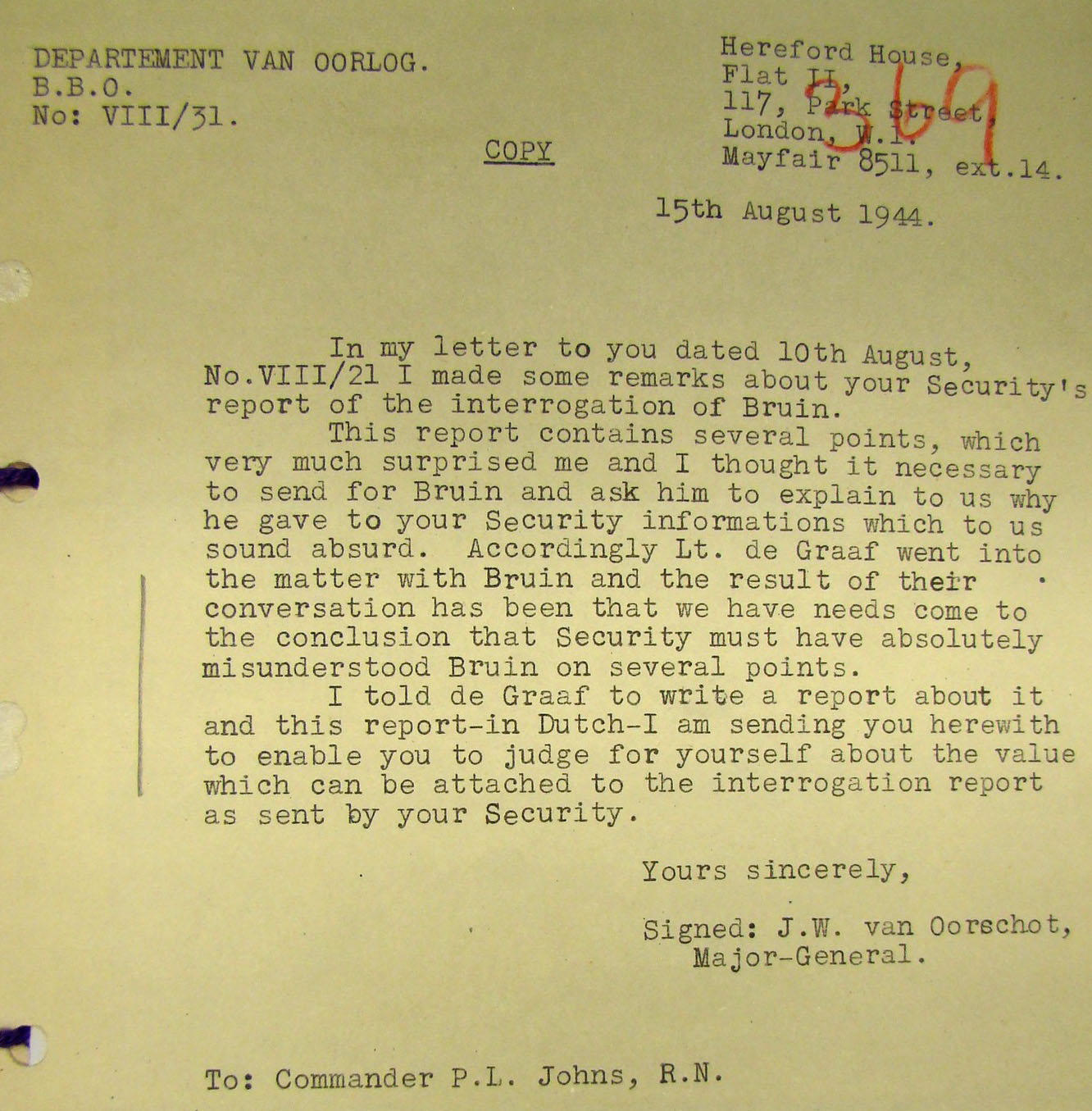
Undersigned, Reserve 1st Lieutenant DE GRAAF, K., interrogated on this day the 14th August 1944, the agent BRUIN (Biallosterski) in connection with the mis-statements which occur in the SOE Security report and which give a completely wrong impression of the Dutch Illegal organisation, the Council of Resistance (Raad van Verzet).
1. In connection with the following quotation:-
"Source was in contact with LO and knows that there is a liaison between the LO and the RVV. He had heard further, while he was in HOLLAND, that the RVV had suffered a good deal of penetration by the Germans, although as far as he could tell LO was not affected by this. The information nevertheless, prevented him from trying to make any contact with the RVV."
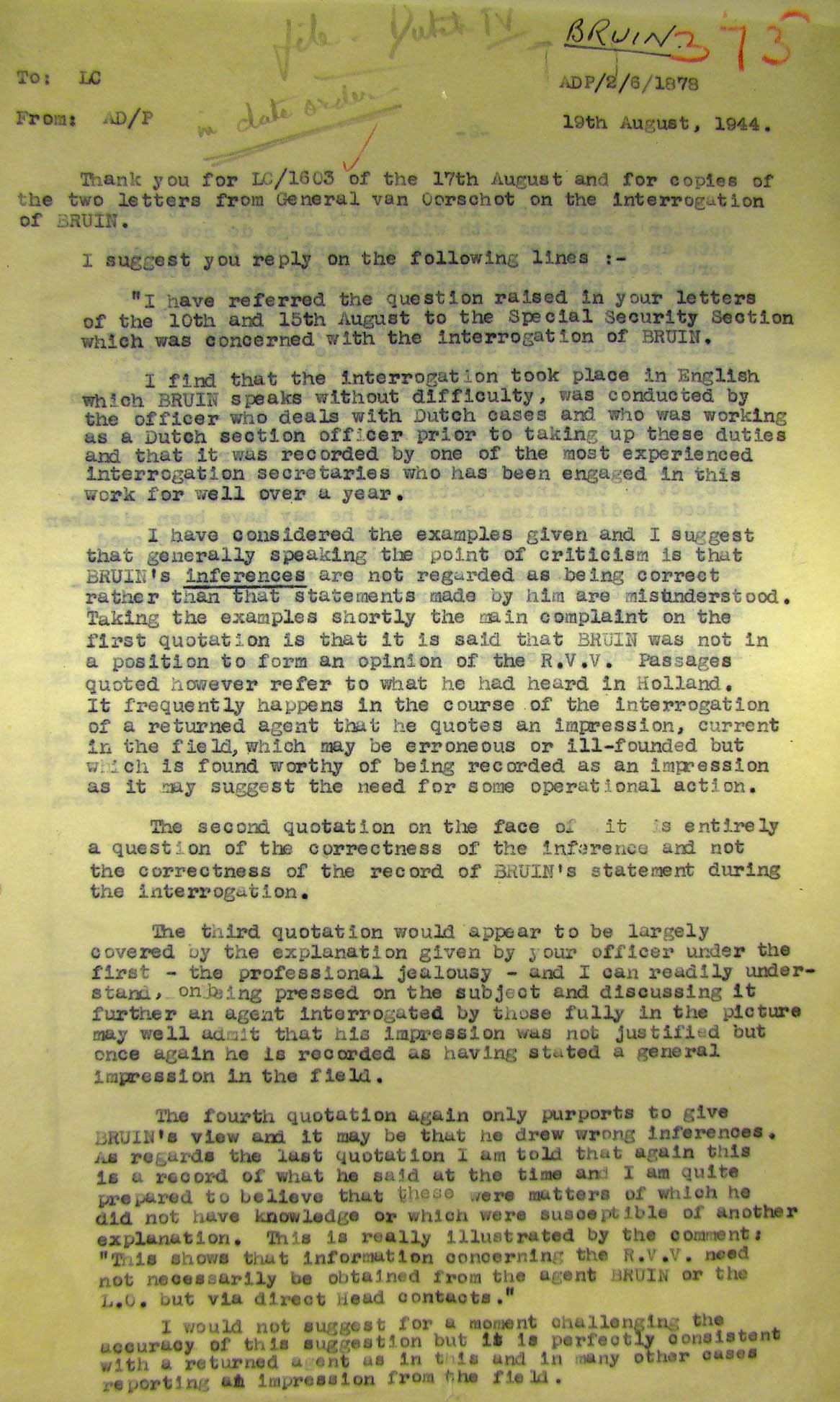
I questioned BRUIN from his reply it seems that this point was wrongly interpreted by the writer of the Security report. "Penetration" that is to say the arrest of a few members of the RVV was not at all the reason BRUIN did not make contact with the RVV; in reality the case is much simpler: BRUIN had no direct contact with the RVV and also did not endeavour to establish a contact. Consequently he was not in a position to form an opinion of the RVV. He was in contact with the LO and there usally exists a form of "jalousie de metier" (professional jealousy) between such organisations, it is on account of this professional jealousy that one organisation is inclined to believe less favourable reports about the other.
2. Questioning BRUIN with regard to the following:-
"In 1943, Source had seen 3 leaflets issued by the RVV which was made it appear as though it was a very big organisation which was trying to coordinate Underground activity in HOLLAND. He added, however, that he had never seen any big work of the RVV."
I have drawn the logical conclusion that the so-called "big-work" of the RVV not being know to Source pleads in its favour, as an efficient organisation endeavours to keep its "big work" completely secret.
3. Quotation 3:-
"he states that the agents, who were subsequently sent to the RVV were sent by some other means than those which he proposed and that he thinks that the whole thing was wrong, since the general impression in HOLLAND is that the RVV despite their own version of themselves, is a reality very small organisation which is fairly thoroughly penetrated".
Likewise it is logical to assume that Source is not in a position to judge the way in which SOE contacted the RVV. That BRUIN's indirect contact were not used is a matter which only concerned the executors of the plans. In addition BRUIN denies emphatically having used the words appearing in the above mentioned paragraph. He declares that the writer of the report has completely misunderstood him. Should the RVV been classified by the LO as a small penetrated organisation, then this should be regarded as the afore-mentioned professional jealousy, and considered as worthless information.
4. Quotation 4:-
"When asked for his views upon the connection between the RVV and the RADIODIENST, Source stated that in his view, penetration of the RVV must extend to the RADIODIENST, but that penetration of the RADIODIENST need not necessarily extend to the RVV. Source stated that he would not agree to go to the RVV from what he has heard about it in HOLLAND, since he thinks it is penetrated and he is of the opinion that, if it is so, as he thinks it is, the enemy must have knowledge of the RADIODIENST."
When interrogating BRUIN on this point it appeared he was ignorant of the fact that the RADIODIENST and the RVV were two completely separate organisations, working on their own, but had contact with each other through a complicated system of cut-outs. The RADIODIENST belongs to the information service of the B.I. (Bureau Inlichtingen). Arrests occuring in either of these organisations does not mean direct "penetration" and certainly not a penetration which would necessarily extend to both organisations.
5. Quotation 5:-
"He had, however, come into contact with RVV indirectly in another way through a relation of his called BALDER from a place named BROEK-OP-LANGEDIJK, who was very Protestant in outlook and had been working for the RVV for about a year. Through him he had discovered that the RVV had no escape routes of its own."
Above-mentioned Mr. BALDER is an indirect contact who does not supply us with any valuable information. The only probable statement BALDER could have made is that the RVV had no escape routes to ENGLAND. I, however, had direct contact with the Head Group of the RVV and knew that this organisation had at least 3 escape routes at its disposal, as follows:-
(a) The organisation SCHARRER.
(b) The organisation SCHRADER.
(c) The organisation VAN TIENHOVEN.
This shows that information concerning the RVV need not necessarily be obtained from the agent BRUIN or the LO but via direct Head contacts.
Finally Source stated that contrary to the mentioned Security report he was aware of the fact that the RVV had no contact with the escape organisation SCHRADER. Moreover the present Minister of Justice Mr. VAN HEUVEN-GOEDHART and undersigned had direct contact with the Head Group of the RVV and they both have an excellent impression of this organisation. Capt. KLIJZING, who had an indirect contact with the MULLER organisation, fully agrees with the opinion that the RVV is one of the most important Dutch resistance and sabotage organisations.
Completed in LONDON,
14 th August, 1944
Agreed by:
(Sgd) K. DE GRAAF
Res. Capt. for A.D. Res. 1st Lieut. B.B.O.
(Sgd) F.J. KLIJZING
Res. 2/Lieut. for A.D.
(Sgd) T. BiallosterskR
14.8.44
INTERROGATION OF THE AGENT BRUIN IN CONNECTION WITH THE REPORT RECEIVED
FROM THE S.O.E. SECURITY CONCERNING THE EXECUTION OF THE ILLEGAL MISSION
Undersigned, Reserve 1st Lieutenant DE GRAAF, K., interrogated on this day the 14th August 1944, the agent BRUIN (Biallosterski) in connection with the mis-statements which occur in the SOE Security report and which give a completely wrong impression of the Dutch Illegal organisation, the Council of Resistance (Raad van Verzet).
1. In connection with the following quotation:-
"Source was in contact with LO and knows that there is a liaison between the LO and the RVV. He had heard further, while he was in HOLLAND, that the RVV had suffered a good deal of penetration by the Germans, although as far as he could tell LO was not affected by this. The information nevertheless, prevented him from trying to make any contact with the RVV."
I questioned BRUIN from his reply it seems that this point was wrongly interpreted by the writer of the Security report. "Penetration" that is to say the arrest of a few members of the RVV was not at all the reason BRUIN did not make contact with the RVV; in reality the case is much simpler: BRUIN had no direct contact with the RVV and also did not endeavour to establish a contact. Consequently he was not in a position to form an opinion of the RVV. He was in contact with the LO and there usally exists a form of "jalousie de metier" (professional jealousy) between such organisations, it is on account of this professional jealousy that one organisation is inclined to believe less favourable reports about the other.
2. Questioning BRUIN with regard to the following:-
"In 1943, Source had seen 3 leaflets issued by the RVV which was made it appear as though it was a very big organisation which was trying to coordinate Underground activity in HOLLAND. He added, however, that he had never seen any big work of the RVV."
I have drawn the logical conclusion that the so-called "big-work" of the RVV not being know to Source pleads in its favour, as an efficient organisation endeavours to keep its "big work" completely secret.
3. Quotation 3:-
"he states that the agents, who were subsequently sent to the RVV were sent by some other means than those which he proposed and that he thinks that the whole thing was wrong, since the general impression in HOLLAND is that the RVV despite their own version of themselves, is a reality very small organisation which is fairly thoroughly penetrated".
Likewise it is logical to assume that Source is not in a position to judge the way in which SOE contacted the RVV. That BRUIN's indirect contact were not used is a matter which only concerned the executors of the plans. In addition BRUIN denies emphatically having used the words appearing in the above mentioned paragraph. He declares that the writer of the report has completely misunderstood him. Should the RVV been classified by the LO as a small penetrated organisation, then this should be regarded as the afore-mentioned professional jealousy, and considered as worthless information.
4. Quotation 4:-
"When asked for his views upon the connection between the RVV and the RADIODIENST, Source stated that in his view, penetration of the RVV must extend to the RADIODIENST, but that penetration of the RADIODIENST need not necessarily extend to the RVV. Source stated that he would not agree to go to the RVV from what he has heard about it in HOLLAND, since he thinks it is penetrated and he is of the opinion that, if it is so, as he thinks it is, the enemy must have knowledge of the RADIODIENST."
When interrogating BRUIN on this point it appeared he was ignorant of the fact that the RADIODIENST and the RVV were two completely separate organisations, working on their own, but had contact with each other through a complicated system of cut-outs. The RADIODIENST belongs to the information service of the B.I. (Bureau Inlichtingen). Arrests occuring in either of these organisations does not mean direct "penetration" and certainly not a penetration which would necessarily extend to both organisations.
5. Quotation 5:-
"He had, however, come into contact with RVV indirectly in another way through a relation of his called BALDER from a place named BROEK-OP-LANGEDIJK, who was very Protestant in outlook and had been working for the RVV for about a year. Through him he had discovered that the RVV had no escape routes of its own."
Above-mentioned Mr. BALDER is an indirect contact who does not supply us with any valuable information. The only probable statement BALDER could have made is that the RVV had no escape routes to ENGLAND. I, however, had direct contact with the Head Group of the RVV and knew that this organisation had at least 3 escape routes at its disposal, as follows:-
(a) The organisation SCHARRER.
(b) The organisation SCHRADER.
(c) The organisation VAN TIENHOVEN.
This shows that information concerning the RVV need not necessarily be obtained from the agent BRUIN or the LO but via direct Head contacts.
Finally Source stated that contrary to the mentioned Security report he was aware of the fact that the RVV had no contact with the escape organisation SCHRADER. Moreover the present Minister of Justice Mr. VAN HEUVEN-GOEDHART and undersigned had direct contact with the Head Group of the RVV and they both have an excellent impression of this organisation. Capt. KLIJZING, who had an indirect contact with the MULLER organisation, fully agrees with the opinion that the RVV is one of the most important Dutch resistance and sabotage organisations.
Completed in LONDON,
14 th August, 1944
Agreed by:
(Sgd) K. DE GRAAF
Res. Capt. for A.D. Res. 1st Lieut. B.B.O.
(Sgd) F.J. KLIJZING
Res. 2/Lieut. for A.D.
(Sgd) T. BiallosterskR

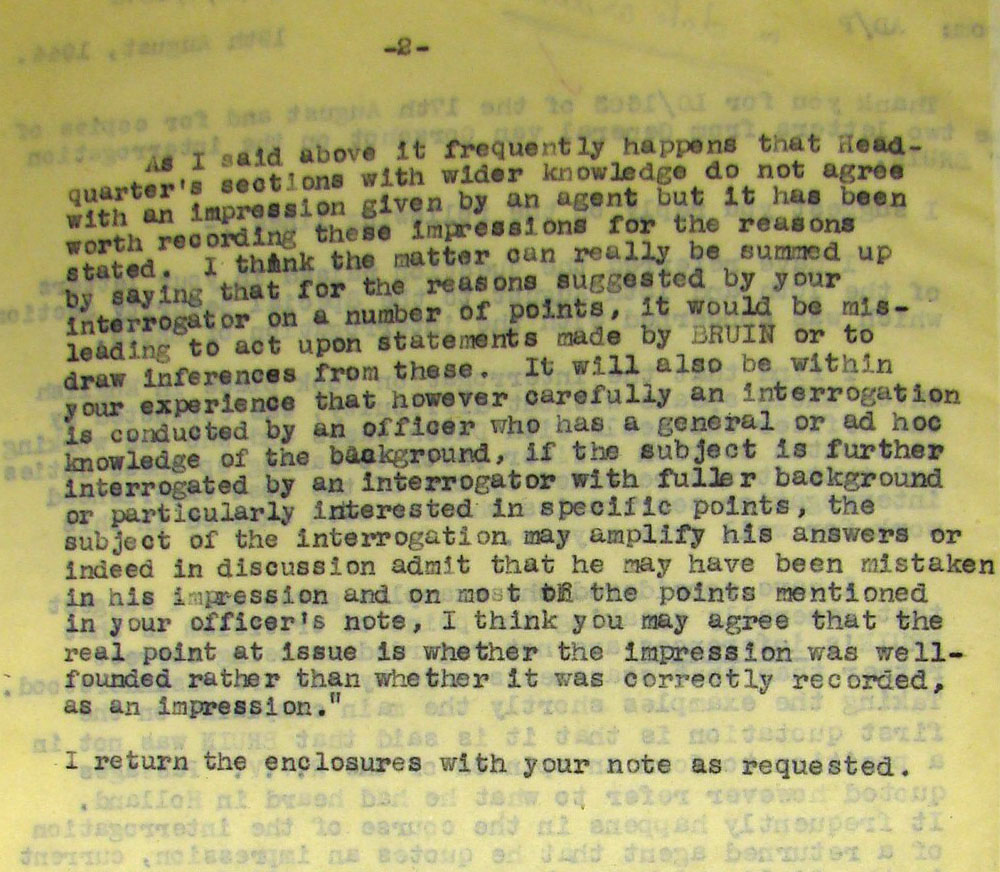

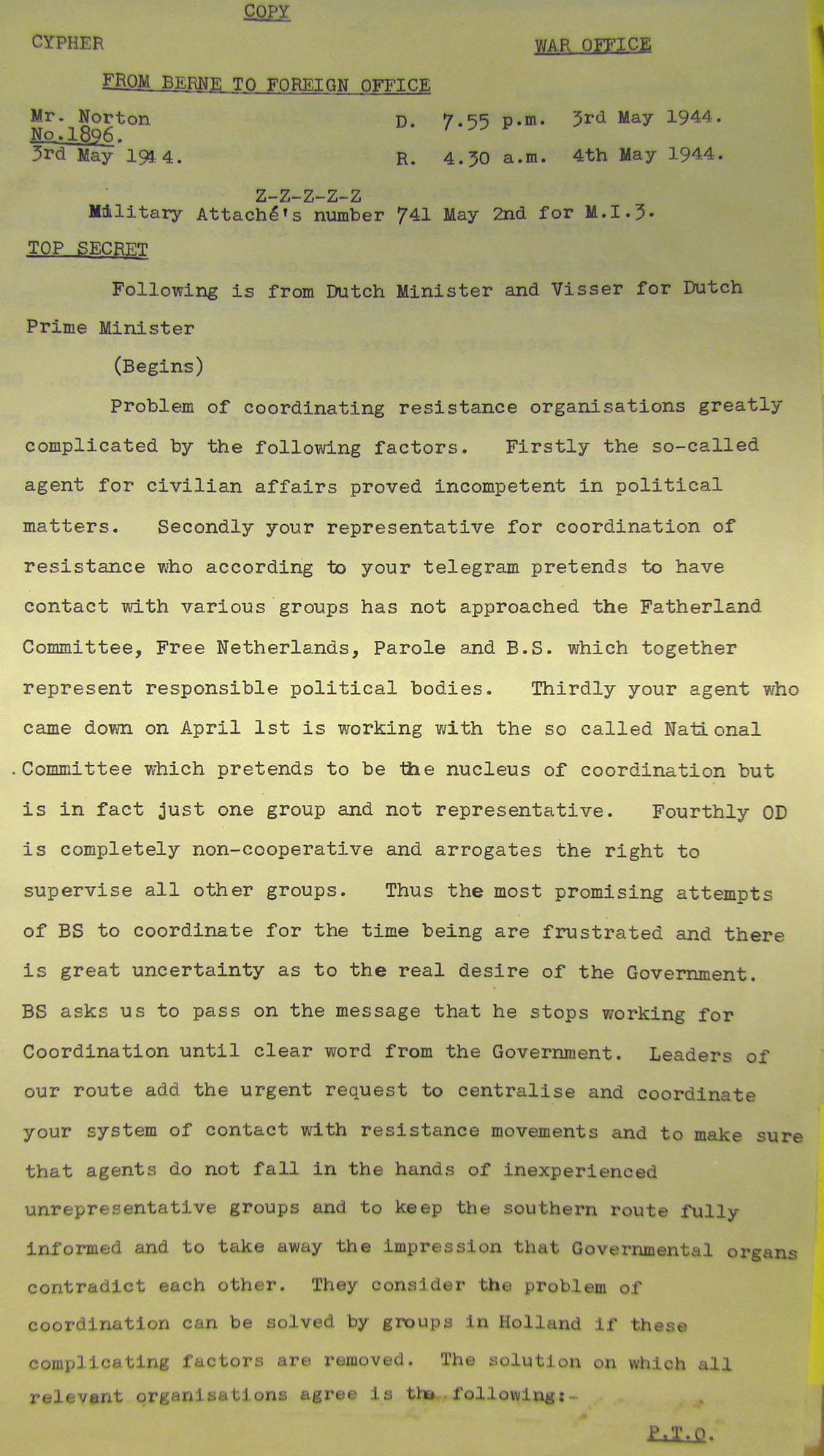
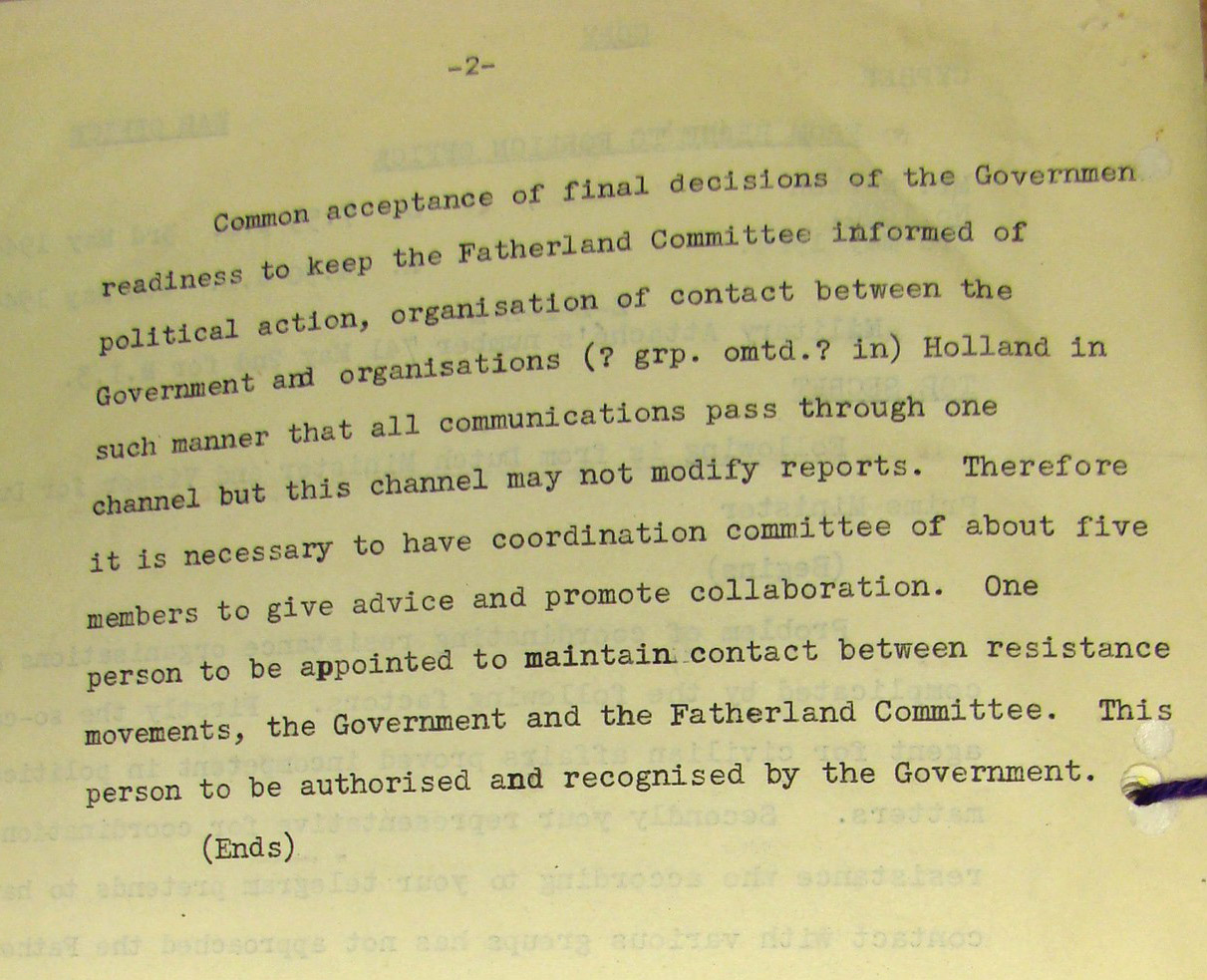
This is a telegram from a Dutch Minister and Reverend Visser, sent from Bern.
It is not entirely clear who is being referred to, but it is clear that Biallosterski is mentioned as the agent who was dropped on 1 April. © TNA, London.
It is not entirely clear who is being referred to, but it is clear that Biallosterski is mentioned as the agent who was dropped on 1 April. © TNA, London.
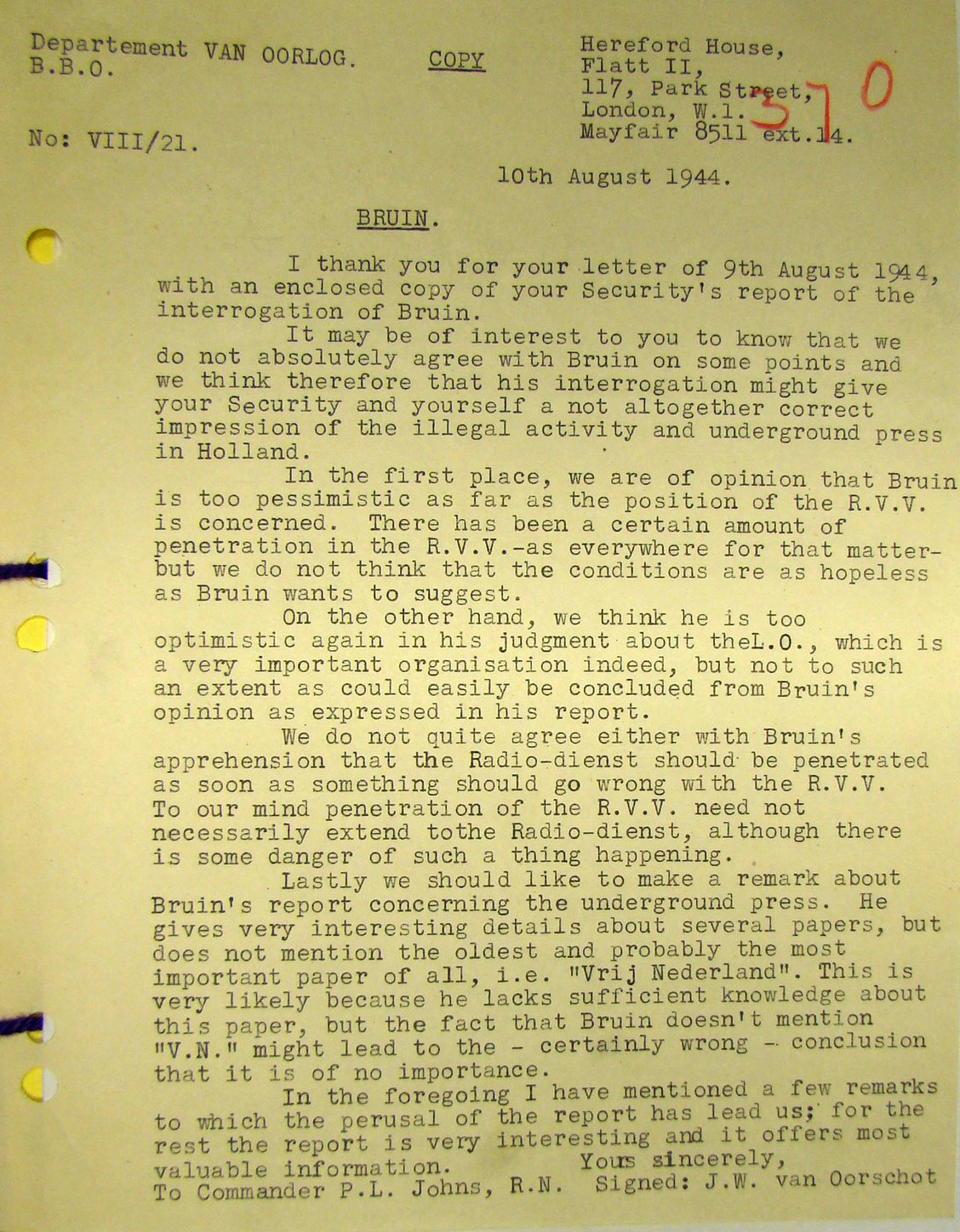
It appears that BBO in London was working to present the RVV as the most important resistance group. Given the telegram from Bern above, it seems there were objections to this. The OD’s obstruction may be due to the fact that this organization had already paid an extremely high price and was nearly wiped out. On the other hand, Six was also playing some questionable games, such as copying and possibly filtering messages sent to Switzerland and appropriating the codes of Group Zwaantje.
The Bram Meerwalt mentioned in the first report is Mr. Arthur Meerwaldt. He was arrested on the evening of 21 January 1944 and died of illness and exhaustion on 8 January in Escherhausen.
The Bram Meerwalt mentioned in the first report is Mr. Arthur Meerwaldt. He was arrested on the evening of 21 January 1944 and died of illness and exhaustion on 8 January in Escherhausen.
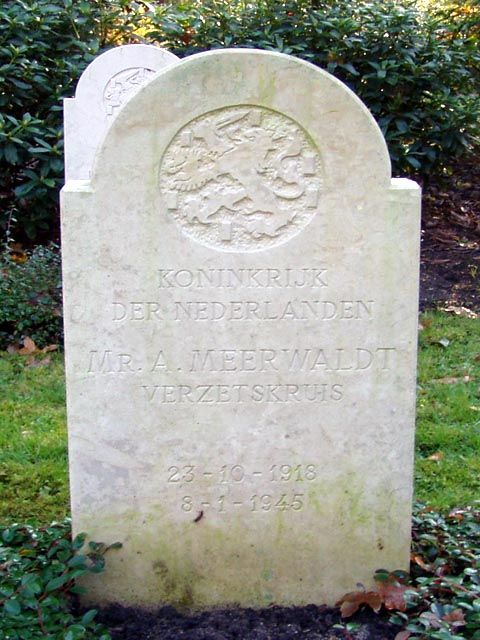
© O.G.S.
OPROEP: Wie was Adriaan de Bak? Was dit een schuilnaam. Wat deed hij na afloop van de oorlog?
Volgens Lizanne Gille van de Universiteit Utrecht, Faculteit Geesteswetenschappen, zou Adriaan de Bak werkzaam zijn bij de Vereniging voor Effectenhandel in Amsterdam, NIOD, 249-1224, Illegale Pers - Je Maintiendrai, a2, Kort rapport over het weekblad: Je Maintiendrai.
Mogelijk gaat het hier om Adriaan de BACK, geboren 3 november 1905 te Velsen.
CALL: Who was Adriaan de Bak? Was this an alias? What did he do after the war?
According to Lizanne Gille of Utrecht University, Faculty of Humanities, Adriaan de Bak may have worked at the Vereniging voor Effectenhandel in Amsterdam, NIOD, 249-1224, Illegale Pers – Je Maintiendrai, a2, Short report on the weekly magazine Je Maintiendrai.
It is possible that this refers to Adriaan de BACK, born 3 November 1905 in Velsen.
Volgens Lizanne Gille van de Universiteit Utrecht, Faculteit Geesteswetenschappen, zou Adriaan de Bak werkzaam zijn bij de Vereniging voor Effectenhandel in Amsterdam, NIOD, 249-1224, Illegale Pers - Je Maintiendrai, a2, Kort rapport over het weekblad: Je Maintiendrai.
Mogelijk gaat het hier om Adriaan de BACK, geboren 3 november 1905 te Velsen.
CALL: Who was Adriaan de Bak? Was this an alias? What did he do after the war?
According to Lizanne Gille of Utrecht University, Faculty of Humanities, Adriaan de Bak may have worked at the Vereniging voor Effectenhandel in Amsterdam, NIOD, 249-1224, Illegale Pers – Je Maintiendrai, a2, Short report on the weekly magazine Je Maintiendrai.
It is possible that this refers to Adriaan de BACK, born 3 November 1905 in Velsen.
This is a telegram from a Dutch Minister and Reverend Visser, sent from Bern.
It is not entirely clear who is being referred to, but it is clear that Biallosterski is mentioned as the agent who was dropped on 1 April. © TNA, London.
It is not entirely clear who is being referred to, but it is clear that Biallosterski is mentioned as the agent who was dropped on 1 April. © TNA, London.
It appears that BBO in London was working to present the RVV as the most important resistance group. Given the telegram from Bern above, it seems there were objections to this. The OD’s obstruction may be due to the fact that this organization had already paid an extremely high price and was nearly wiped out. On the other hand, Six was also playing some questionable games, such as copying and possibly filtering messages sent to Switzerland and appropriating the codes of Group Zwaantje.
The Bram Meerwalt mentioned in the first report is Mr. Arthur Meerwaldt. He was arrested on the evening of January 21st 1944 and died of illness and exhaustion on January 8th in Escherhausen, Germany.
The Bram Meerwalt mentioned in the first report is Mr. Arthur Meerwaldt. He was arrested on the evening of January 21st 1944 and died of illness and exhaustion on January 8th in Escherhausen, Germany.
WEGGUM.COM